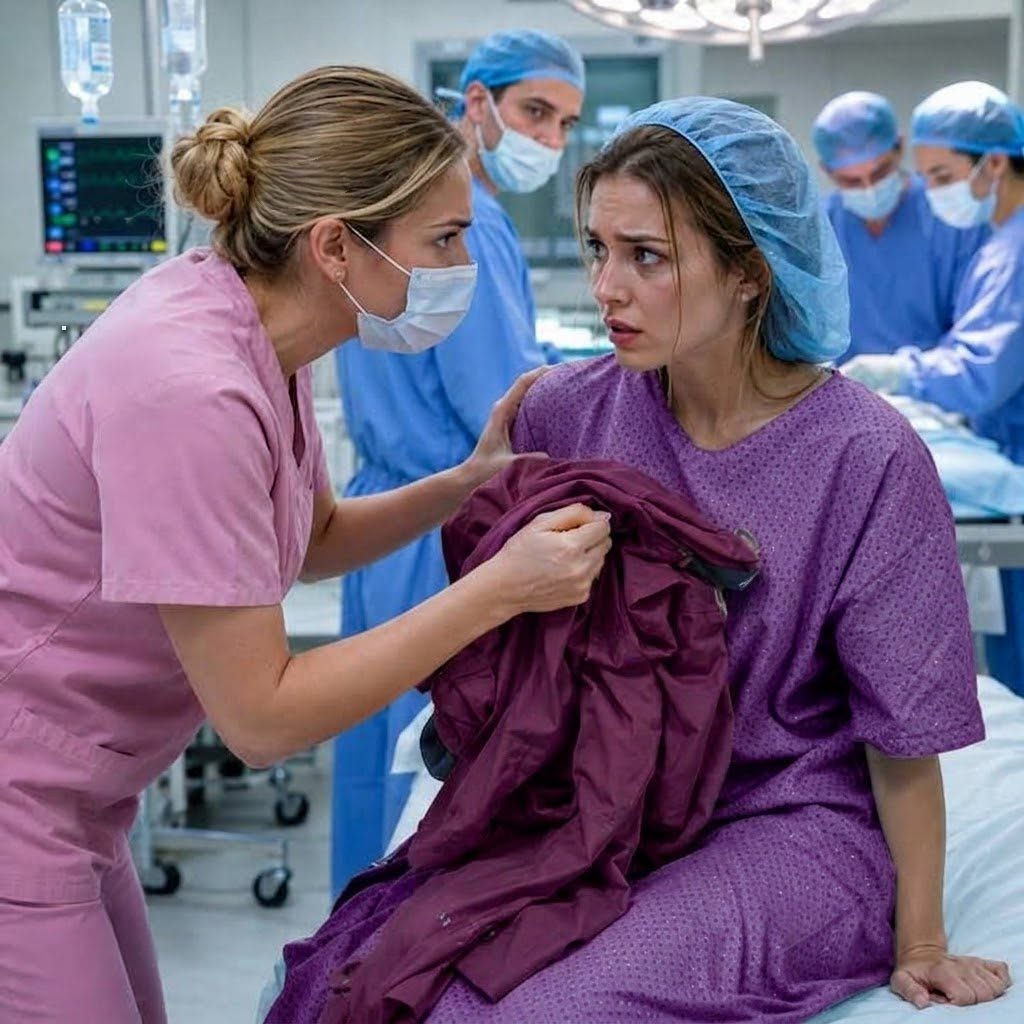
Elena grasped the service exit handle just as the footsteps stopped outside my room.
She glanced at me, placed a finger to her lips, and opened the door wide enough for us to sneak into a narrow service corridor filled with supply carts and stacks of clean linens.
My knees felt weak.
Beneath the gray janitor uniform, I still wore the hospital gown, and every few steps, the plastic wristband rubbed against my skin, a reminder that less than an hour ago, I had been waiting calmly for someone to take me into surgery.
Suddenly, my room door swung open.
“Ana?” Diego called out.
I nearly responded without thinking.
That frightened me more than the footsteps.
For years, his voice had been the one I relied on when things went wrong. He was the man who remembered my coffee preferences, who drove back across town because I left my work keys on the kitchen counter, who sat beside me when my father was ill, never complaining about the hard plastic waiting-room chairs.
He had comforted me when Salgado gave us the diagnosis.
He had cried on my shoulder.
He had told me he would rather die than let me sacrifice a part of myself for him.
And now, I was hiding from him in a cleaning uniform.
Elena pulled me behind a tall linen cart just as voices spilled into the hallway we had just left.
“What do you mean she’s gone?” Beatriz demanded.
Fernanda spoke first. “She couldn’t have gone far.”
Then Salgado’s voice came through, low and steady. “Keep your voices down. We have staff on this floor.”
There was a brief pause.
I pressed both hands over my mouth.
Then Beatriz said the word that shattered whatever was left of my old life.
“Find the merchandise.”
My stomach twisted.
Fernanda hissed, “Mom.”
“What?” Beatriz snapped. “That’s what she is to them now. If this falls apart, none of us gets anything.”
Nothing in her tone sounded confused.
Nothing sounded forced.
Nothing sounded like a mother terrified that her dying son might lose his only chance at life.
Elena’s hand gripped my forearm.
We moved.
The service corridor curved around the back of the surgical wing and ended at a heavy stairwell door. Elena swiped her badge, pushed it open, and signaled for me to go through.
Before the door closed, Diego shouted my name again.
This time his voice was nearer.
Then I heard running.
Running.
Not the uneven shuffle of a man too weak to walk across our apartment unaided. Not the cautious steps of a patient who had arrived in a wheelchair, looking as if a flight of stairs might kill him.
Quick footsteps.
Strong footsteps.
Elena saw my expression.
“That part was fake too,” she said.
The stairwell seemed to tilt beneath me.
I clutched the railing.
“Show me.”
“What?”
“You said his results were falsified. Show me something.”
She stared at me as if she couldn’t believe I was stopping.
“Ana, we need to get you out.”
“I have spent two months believing I might cut open my body to save that man. I need one thing that is real.”
Elena reached into the pocket of her scrub jacket and pulled out two folded sheets.
She didn’t hand me a dramatic secret file or some perfect confession.
She revealed something smaller.
Two lab reports bore the same patient name, the same collection time, and the same specimen reference, but several values differed.
One version was the report I remembered Salgado showing us.
The other did not depict the dying man I had been caring for.
“I found the original while reconciling his chart,” Elena whispered. “I thought someone had attached the wrong document. Then I checked the history.”
She swallowed.
“The altered version appeared later.”
My hand trembled so much the pages quaked.
“Who changed it?”
“I can’t prove who typed it. I can tell you who signed the note that relied on it.”
“Salgado.”
She nodded.
Above us, the stairwell door slammed open.
Elena snatched the papers back.
“Go.”
We hurried downward.
At the next landing, I heard Diego calling my name, softer now, using the tone he used when we fought and he wanted me to believe everything could still be fixed.
“Ana, please. You’re scared. Just stop and talk to me.”
I kept descending.
“Ana, Elena is confused.”
Another flight.
“Salgado can explain everything.”
Another.
Then Diego said, “Don’t make this worse.”
That sentence did what his pleading could not.
It steadied me.
We reached the lower level, where the air was tinged with detergent and wet concrete. Elena pointed toward a corridor leading to a loading entrance.
“Outside is that way.”
I started after her, then hesitated.
The loading area would be almost empty at this hour.
Rain continued to pound the building. I had no shoes except the hospital socks on my feet, no phone, no wallet, and no idea how many people Salgado had involved.
If I slipped out through a back door, Diego could tell everyone his frightened wife had suffered some kind of breakdown before surgery.
He could say Elena kidnapped me.
He could say anything.
I turned around.
Elena looked at me. “What are you doing?”
“I’m not leaving through the back.”
“Ana—”
“I want people.”
Understanding dawned on her face.
“The main lobby?”
“The main lobby.”
For the first time that night, I made a decision that wasn’t based on what Diego needed.
We cut through another service passage toward the public side of the hospital.
The building felt different once I stopped viewing it as a place where I was supposed to obey orders. Every door became a choice. Every desk became a potential witness. Every person who didn’t know Salgado became someone he couldn’t completely control.
We were nearly at the lobby corridor when he appeared ahead of us.
Dr. Salgado.
His white coat was unbuttoned, and the calm demeanor I had seen during every appointment had hardened into something colder.
“Ana,” he said. “Come back upstairs.”
I halted several yards away.
“No.”
“You are under extreme emotional stress.”
“I said no.”
He glanced at Elena. “You have created a dangerous situation.”
Elena opened her mouth, but I spoke first.
“I withdraw my consent to every procedure.”
Salgado took one step toward me.
I raised my voice.
“I do not consent to surgery. I do not consent to medication. I do not consent to being taken anywhere with you.”
The words echoed into the public corridor.
A man sitting with a paper coffee cup turned to us. A woman near the vending machines looked up. Someone behind the front desk stopped typing.
Salgado’s expression shifted only slightly.
“Ana, nobody is forcing you to do anything.”
“Then stay where you are.”
He halted.
Good.
Elena moved beside me instead of in front of me.
That mattered.
She had warned me. She had shown me the conflicting reports. But she was not going to become the one making my choices for me after I had just realized how many people already had.
Then Diego rounded the corner.
He was not in the wheelchair.
He was running.
He slowed the instant he saw the people watching us, but it was too late.
His complexion appeared better than it had upstairs. His back was straight. His legs supported him effortlessly.
I stared at him.
He stared back.
Neither of us needed to mention the wheelchair.
“Ana,” he said softly. “Come here.”
“No.”
His jaw clenched.
“We need to talk privately.”
“No.”
“You’re my wife.”
That used to be enough.
Not anymore.
Beatriz and Fernanda appeared behind him. Beatriz still wore the soft cardigan she had wrapped around herself while sitting beside my bed earlier, telling me I was the angel saving her son.
Fernanda looked terrified.
Not for me.
For herself.
Beatriz approached slowly. “Sweetheart, you misunderstood something.”
I looked at her.
“Did you call me merchandise?”
Her step halted.
Fernanda stared at the floor.
Diego said, “Mom was upset.”
“So she said it?”
“No one is saying that.”
“I heard her.”
Beatriz’s face hardened. “You have no idea what is at stake.”
There it was again.
Not my life.
What was at stake.
Salgado attempted to regain control. He told the front-desk employee that I was a preoperative patient experiencing severe anxiety and needed to be returned to the surgical floor for evaluation.
I walked directly to the desk.
“Call outside law enforcement,” I stated. “And call whoever is responsible for the hospital tonight. I am an adult patient declaring that I believe my medical records were falsified and that people are trying to take me into surgery against my will.”
The employee looked from me to Salgado.
Salgado said my name sharply.
I didn’t turn around.
The employee reached for the phone.
Diego moved toward me.
Elena stepped aside rather than blocking him, leaving a clear space between us.
That was when I grasped something ugly about fear: sometimes the safest thing you can do is make the other person choose their next action where everyone can see it.
Diego paused before touching me.
He lowered his voice.
“You are destroying our lives.”
I finally looked at him.
“You told me you were dying.”
“I can explain.”
“You sat in a wheelchair.”
“Ana—”
“You watched me sign.”
His eyes flicked toward the front desk.
He wanted privacy more than he wanted forgiveness.
That told me enough.
Beatriz began crying, but even then, she kept glancing toward Salgado as if waiting for instructions.
Fernanda did something different.
She began backing away.
Salgado noticed.
“Fernanda,” he said.
She froze.
Beatriz turned on her. “Don’t.”
Fernanda looked at her mother, then at Diego.
“You said there was no other way,” she whispered.
Diego’s face tightened.
“Stop talking.”
“You said she’d never know.”
“Fernanda.”
Her breathing became shallow.
Then she looked at Salgado.
“You promised she would already be asleep before anything changed.”
The words resonated differently because she did not shout them.
She sounded like someone realizing the truth for the first time.
A security supervisor had reached the desk by then. He didn’t make a speech. He asked me one simple question.
“Do you want to leave with any of these people?”
“No.”
“Do you want any of them making medical decisions for you?”
“No.”
He nodded once and instructed another employee to keep the lobby clear until outside officers arrived.
Salgado objected immediately.
The supervisor replied that I had withdrawn consent and was remaining voluntarily in a public area.
That was all.
No dramatic takedown.
No instant justice.
Just a boundary that others could hear.
Elena unfolded the two lab reports and handed them to the supervisor only after I told her to.
She explained the mismatch in straightforward language and nothing more.
Same patient.
Same collection reference.
Different values.
One version entered later.
One physician had relied on the later version to support the narrative I had been told for weeks.
Salgado claimed it was a documentation error.
Then Fernanda laughed once, a broken little sound.
“A documentation error?” she said. “Is that what you’re calling it now?”
Beatriz grabbed her arm.
Fernanda pulled away.
Diego did not defend his sister.
He did not defend me either.
He looked toward the corridor as if calculating whether he could still leave without making things worse.
Two outside officers arrived before he decided.
I spent the next several hours answering the same questions in various ways.
No, Diego had never informed me his diagnosis was uncertain.
No, I had never consented to donate anything except a kidney.
No, I had never agreed to any other procedure.
Yes, Salgado had personally explained the supposed compatibility result.
Yes, Beatriz and Fernanda had participated in the discussions about my donation.
Yes, I had heard Beatriz refer to me as “the merchandise.”
And yes, Diego had arrived in a wheelchair and later chased me through the hospital on foot.
By morning, the gray uniform was still on my body.
Someone brought me shoes.
Someone else cut off the wristband only after photographing it with the paperwork I had been wearing when I fled the pre-op room.
The investigation that followed did not yield one magical document explaining everything.
It unraveled into smaller pieces.
There were two versions of Diego’s lab results with matching collection information but conflicting values.
There were chart timestamps that didn’t fit the sequence Salgado initially described.
There were scheduling records linked to my surgery that hospital administrators couldn’t reconcile with the kidney donation I had authorized.
Most importantly, there was my original consent.
It stated kidney.
Nothing else.
Diego’s actual medical history was assessed separately.
He did not have the end-stage kidney failure I had been led to believe he had.
The weeks of weakness, the wheelchair, the promises about Europe, the talk of our new life afterward—those were not pieces of a tragic illness.
They were part of getting me to the operating room voluntarily.
The deeper motive took longer to establish.
Investigators eventually uncovered evidence that money had been promised through individuals connected to the illegal arrangement, with Salgado acting as the link between a patient who needed a heart and the people who had decided my life could be turned into a transaction.
The recipient’s identity was kept from me for a long time, and eventually, I stopped asking.
I didn’t need another stranger’s tragedy to explain my husband’s choice.
Diego tried to distance himself from Salgado as soon as he realized the hospital was preserving records.
He claimed Salgado had manipulated everyone.
He said his mother had pressured him.
He said Fernanda understood more than he did.
He said he had believed there would be a last-minute medical reason to halt the procedure before I was seriously harmed.
He said many things.
But the issue with a lie built over months is that eventually, it has to survive its own history.
He had attended the appointments.
He had watched me alter my diet before surgery.
He had seen Beatriz count my vitamins.
He had witnessed Fernanda bring fruit and expensive pajamas to a woman she had barely tolerated before.
He had watched me sign the paperwork.
He had kissed my forehead on the night I thought I was going to save him.
And when Elena aided my escape, he had not called after me like a frightened husband worried his wife might get hurt.
He had chased me.
Fernanda became the first family member to fully cooperate.
That did not make her innocent.
She never asked me to forgive her, which may have been the first decent decision she made after the truth emerged.
She admitted that Salgado had described the plan in gentler terms at first, then more clearly as the date approached. She admitted that everyone understood I was not supposed to wake up and learn what had actually occurred.
Beatriz continued to insist that desperation had clouded her judgment.
I believed the second half.
I did not accept the first as an excuse.
Diego requested to see me once before the case against them progressed.
I declined.
Then he wrote a letter.
I left it unopened for nearly three weeks.
When I finally read it, he spent four pages detailing his fear, his mother’s influence, Salgado’s promises, the life he thought the money would buy, and the moment he realized he had gone too far.
There was one thing missing.
Me.
Not my future.
Not my fear.
Not the body he had slept beside for years while knowing strangers were discussing it as something that could be transferred, priced, and removed from the world.
I folded the letter and gave it to my attorney with the rest of the material.
I never responded.
Elena’s role was quieter.
She provided formal statements about what she had observed in the chart and why she believed I was in immediate danger. She handed over the original report she had discovered and explained the sequence of entries she had noticed.
She never claimed to know everything.
That made me trust her more.
Months later, when we met for coffee, I asked why she had risked helping me.
She rubbed both hands around the paper cup for a long time before responding.
“Because you were awake,” she said.
I frowned.
She looked at me.
“You were sitting there talking about your husband. You were scared for him. Everyone around you was discussing you as if the decision had already been made. I realized you were the only person in that room who didn’t know what the room was truly for.”
That answer stayed with me.
Not because it was beautiful.
But because it was ordinary.
She saw a person who still had the right to choose, and she acted as if that mattered.
The criminal cases took time. The professional investigations took time. My divorce took time, too.
There was no single afternoon when I suddenly felt whole again.
For months, hospitals made my palms sweat.
A wheelchair in a grocery-store parking lot could freeze me in place for reasons I hated having to explain.
I checked locks twice.
I woke up whenever rain hit the windows hard enough to sound like that night.
But ordinary life returned in fragments.
I returned to work.
I learned to eat breakfast without someone monitoring what vitamins I had consumed.
I bought groceries because I wanted them, not because Beatriz had decided what a donor should eat.
I stopped hearing Diego’s voice every time my phone rang.
One afternoon, nearly a year after the night of the surgery, I opened a storage box in my apartment and found the gray janitor uniform folded beneath a stack of case papers.
I had forgotten I still had it.
For several minutes, I just stood there holding it.
The fabric was cheap and rough.
One sleeve still had a faint crease where Elena had pulled it over my hospital bracelet.
Once, that uniform had been a disguise.
Then it had been my escape.
Now it was merely something that belonged to someone who had helped me when everyone close to me had decided my consent no longer mattered.
I placed it in a paper bag and drove to meet Elena after her shift.
She smiled when she saw what I was carrying.
“I wondered where that went.”
I handed her the bag.
She began to push it back toward me.
“Keep it.”
I shook my head.
“I don’t need it anymore.”
Elena studied my face, then accepted the bag.
We finished our coffee and walked together toward the hospital entrance.
At the doors, she turned toward the employee corridor.
I continued straight.
This time there was no service passage, no borrowed uniform, no husband calling after me, and no one deciding where I was allowed to go.
I pushed open the front door with my own hand and stepped outside.