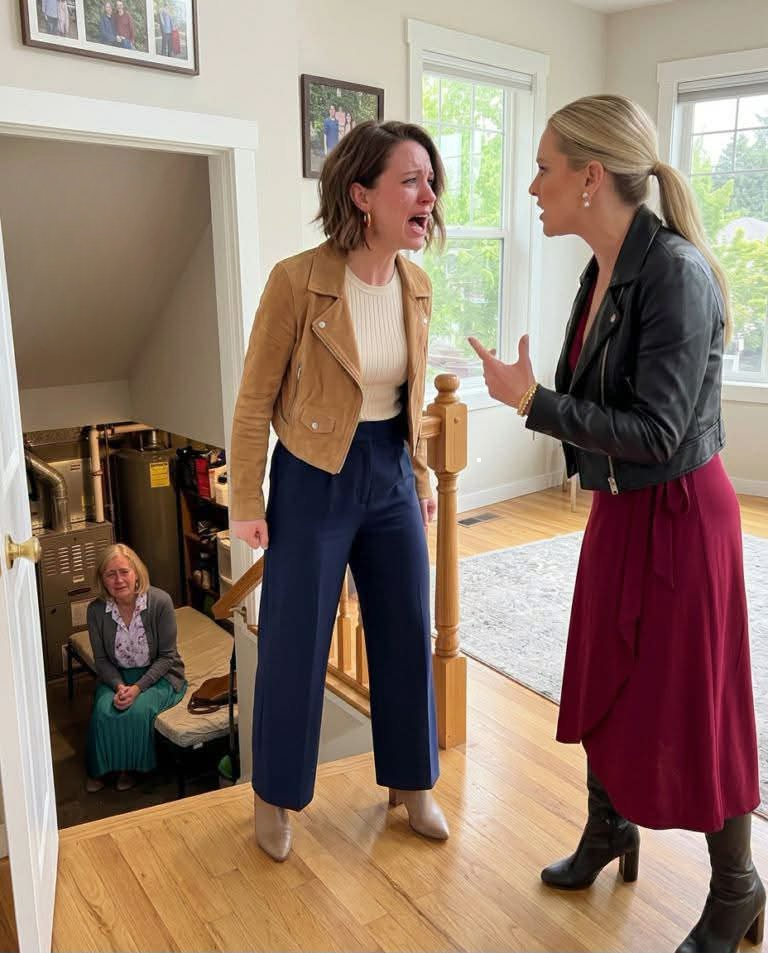
I returned home after six years overseas, intending to surprise Mom in the house I had purchased for her. Instead, my sister greeted me at the door wearing Mom’s jewelry. When I inquired about Mom’s whereabouts, she directed me toward the basement. Her response made me smile. A few hours later, precisely at 9 p.m., two men knocked on the front door.
After six years in Singapore, I arrived in Seattle with one suitcase, a carry-on, and the naive grin of a daughter convinced she was about to give her mother the shock of her life.
The house resembled the closing photos: pale blue siding, white porch rails, and two maple trees in front. I had bought it for Mom three years prior after Dad passed away, sending the down payment and all mortgage payments from abroad.
I pressed the doorbell.
My younger sister, Vanessa, opened the door sporting Mom’s pearl earrings and the gold bracelet Dad gifted her on their twenty-fifth anniversary.
“Oh,” she remarked. “You’re back.”
No hello. No welcome home.
I peered past her. Three unfamiliar cars occupied the driveway. A man in workout clothes crossed the upstairs hallway clutching a towel.
“Where's Mom?”
Vanessa crossed her arms. “Basement.”
I thought I must have misheard.
“What?”
“She sleeps downstairs now. The upstairs rooms are for those who pay.”
The basement door was next to the kitchen. I proceeded down without taking off my shoes.
Mom was asleep on a narrow cot beside the furnace, bundled in a winter coat despite it being June. There was no proper bedroom, just storage shelves, detergent boxes, and an old lamp. Her prescription bottles rested on a folding chair.
Her face was thinner than it had appeared during our video calls. The camera had always been tightly framed, never revealing the room. I suddenly grasped why Vanessa insisted Mom was “too tired” whenever I asked her to walk around the house with the phone.
When Mom awakened and saw me, she started crying before saying my name.
Vanessa followed me downstairs. “Don’t make a scene. She agreed.”
Mom stared at the ground.
I asked, “Agreed to what?”
Vanessa sighed. “I manage the property. She needs supervision. The renters cover expenses.”
“The mortgage is paid from my account.”
“Utilities aren’t free.”
I glanced around again. No smoke detector near the cot. No window large enough for an emergency exit. A space heater plugged into an overloaded extension cord.
Then I noticed a stack of envelopes on a shelf, all addressed to me, unopened and concealed behind paint cans.
My smile returned.
Not because anything was humorous.
Because Vanessa had finally made a blunder significant enough to confirm everything.
“You just made this very easy,” I stated.
At 7:12 p.m., I documented every room with photos. At 7:35, I contacted the attorney who managed the purchase. At 8:10, I forwarded her the deed, bank records, and photos.
At precisely 9:00, two men knocked on the front door.
Vanessa answered.
One displayed a badge.
The other held a red notice from the city.
The man with the badge was Officer Daniel Brooks from Seattle Police. Next to him stood Marcus Hale, a city code-compliance officer called in after my attorney reported an immediate fire and occupancy issue.
Vanessa’s demeanor shifted upon seeing the red notice.
“This is private property,” she snapped.
I stepped beside her. “My property.”
That silenced her.
The deed had always remained in my name. Mom had lifetime use of the house while I handled the mortgage, taxes, insurance, and major repairs. Vanessa was aware of this. She had simply relied on me being twelve time zones away.
Officer Brooks requested to talk with Mom privately. Vanessa immediately claimed Mom was confused.
“She has good days and bad days.”
From the basement, Mom called, “I know exactly what day it is.”
I nearly laughed with relief.
Marcus inspected the basement first. He took photos of the blocked window, extension cord, space heater, and furnace clearance before heading upstairs.
Four bedrooms had locks installed on the outside doors. Three were occupied by renters. One tenant, a nursing student named Caleb, showed us his payment history.
“Eighteen hundred a month,” he said. “Vanessa said she owned the house.”
Another renter paid sixteen hundred.
The third paid seventeen-fifty.
I calculated it mentally and felt cold.
Vanessa had been collecting over five thousand dollars each month while telling me Mom needed extra funds for groceries and medication. I had also been sending an additional eight hundred on top of every household bill.
Officer Brooks inquired where the rental income went.
“Expenses.”
“Which expenses?”
She crossed her arms. “I don’t have to explain my finances.”
“You may have to clarify someone else’s,” he replied.
Then Mom asked me to open the bottom drawer of the basement dresser.
Inside was a blue folder.
Bank statements. Copies of checks. A handwritten ledger.
And a document titled PROPERTY MANAGEMENT AUTHORIZATION.
My mother’s signature was at the bottom.
Mom glanced at it for barely a second.
“I never signed that.”
Vanessa turned pale.
I stared at her. “You forged her name?”
“She told me I could handle things.”
“That isn’t what I asked.”
“She would have signed it.”
“But she didn’t.”
For the first time that night, Vanessa’s composed demeanor faltered. “You abandoned us,” she said. “You got to live overseas, make money, post pictures from Singapore, and pretend sending checks made you a daughter. I was here.”
Mom spoke softly behind me.
“You were here because you lost your apartment.”
Vanessa turned.
Mom continued, her voice growing stronger. “I let you stay six months. Then you took my bedroom. Then you rented Clara’s room. Then you told me the basement was temporary.”
My name is Clara.
Hearing Mom say it felt like a locked door had finally been opened.
The officer asked whether Vanessa had ever threatened her.
Mom hesitated.
Vanessa glared at her.
That was answer enough.
Officer Brooks stepped between them.
Mom swallowed. “She said if I told Clara, she would put me in a nursing home and tell everyone I had dementia.”
Vanessa shouted, “That is not what happened!”
One renter came halfway down the stairs.
Marcus instructed everyone to remain calm.
Then my phone buzzed.
My attorney had emailed a scan of a document recorded with the county four months prior.
A quitclaim deed.
It stated I had transferred ownership of the house to Vanessa.
The signature at the bottom was allegedly mine.
I had been in Singapore on the date it was notarized in Washington.
I turned my screen toward Officer Brooks.
He read it twice.
Then looked at Vanessa.
“Ms. Mercer,” he said, “I strongly recommend you stop talking until you have an attorney.”
For once, my sister complied.
Vanessa did not leave in handcuffs that night.
That shocked me more than anything.
I had envisioned crimes working like they do on television: show the forged deed, show the frightened mother, point to the guilty person, and someone gets arrested before the next commercial.
Real life progressed slower.
Officer Brooks explained that the deed, management authorization, bank records, and Mom’s statement all needed to be properly documented. The county recording office had to verify the filing. The notary information needed checking. The renters also had legal rights, even if Vanessa had no right to rent them the rooms.
So the first victory was smaller but more crucial.
Mom came upstairs.
Marcus declared the basement unsafe for sleeping. I moved Mom into the downstairs guest room Vanessa had been using as an office. Vanessa protested until Officer Brooks reminded her Mom had established residency long before she had.
I slept on the living-room sofa.
Nobody got much sleep.
At six the following morning, I found Mom at the kitchen table wearing one of Dad’s old cardigans. The pearls and bracelet were lying in front of her.
Vanessa had placed them there sometime overnight.
Mom touched the bracelet with one finger.
“She took more than these.”
“What else?”
Mom gave me a weary look. “Your father’s watch. My emerald ring. The silver tea service from Grandma. She said she was putting things somewhere safe.”
“Did she?”
“I stopped asking.”
That sentence stung more than Vanessa shouting at me.
I made coffee and opened my laptop.
By eight, my attorney, Rachel Kim, joined us via video call. Rachel had managed the original purchase and still had certified copies of my deed and closing documents. She explained that recording the quitclaim deed did not automatically settle ownership. A forged instrument could be challenged, and the title company’s fraud department required immediate notification.
“What do we do about the renters?” I asked.
“Nothing hasty,” Rachel advised. “Do not change locks. Do not shut off utilities. Do not throw out property. We handle each tenancy according to Washington law.”
That was when I realized how much damage Vanessa had caused.
Three strangers had paid thousands of dollars in good faith. They were not my enemies. They had been deceived as well.
At nine, I gathered them in the kitchen.
Caleb came down first. The other two were Priya Shah, a software tester, and Jordan Ellis, a restaurant manager. All three looked terrified I was about to put their belongings on the curb.
“I’m not doing that,” I assured them. “You’ll receive everything in writing. Until my lawyer sorts this out, nobody is being forced onto the street today.”
Priya exhaled so sharply I heard it across the table.
Then Jordan said, “There’s something you should see.”
He opened his phone.
Vanessa had advertised the rooms through a local housing group. The listing described the property as “owner-managed.” She had also charged each tenant a security deposit.
None of those deposits had been placed where Rachel expected a landlord to account for them.
Then Caleb showed me a text Vanessa had sent two weeks earlier.
If the older woman downstairs asks you questions, don’t give her information. She gets confused.
Mom read it over my shoulder.
Her expression remained unchanged, but she pushed away her coffee.
That afternoon, the title company contacted Rachel.
The notary listed on the quitclaim deed was genuine.
The notarization was not.
His commission number had been copied from an unrelated public record, and he confirmed he had never met me or notarized anything bearing my name.
The signature was forged.
The acknowledgment was fake.
And Vanessa had used the fraudulent deed to open a home-equity line of credit.
One hundred and twenty thousand dollars.
I asked Rachel to repeat the amount.
Mom covered her mouth.
I stepped into the backyard because suddenly I couldn’t breathe in that kitchen.
Six years of work flashed before my eyes: overnight flights, missed holidays, conference rooms, lonely hotel breakfasts, every month I transferred money into an account labeled MOM HOUSE.
Vanessa had turned it all into collateral.
When I came back inside, she stood at the bottom of the stairs with a suitcase.
“I’m leaving,” she announced.
Rachel, still on speakerphone, instructed me not to interfere.
I didn’t.
Vanessa pulled the suitcase toward the front door, then halted beside Mom.
“You’re really choosing Clara?”
Mom looked up.
“No,” she replied. “I’m choosing myself.”
Vanessa let out a bitter laugh.
“You think she’s better than me because she paid for everything?”
“No.”
“Then what?”
Mom answered softly.
“She never made me afraid to answer my own phone.”
Vanessa’s face hardened.
She departed without saying goodbye.
For the next three weeks, the house transformed into an office.
Detectives interviewed Mom twice. A financial-crimes investigator gathered copies of transfers, rental payments, and the forged deed. Adult Protective Services interviewed Mom separately, documenting the living conditions and threats she described.
Rachel filed the civil action needed to clear the fraudulent deed from the title record and notified the lender that the equity loan was disputed as fraud.
I discovered Vanessa had not spent the money on one dramatic purchase.
There was no secret mansion. No luxury car hidden somewhere.
It had evaporated in pieces.
Credit-card debt.
Online shopping.
A leased SUV she could barely afford.
Two trips to Miami.
A failed boutique she had never mentioned.
Cash withdrawals.
Sports betting deposits.
And almost fourteen thousand dollars sent to a man named Eric whom none of us recognized.
That somehow felt worse.
She had risked Mom’s home not for survival but because each poor decision demanded another lie to cover the previous one.
The missing jewelry turned up at three pawn shops.
Dad’s watch was retrieved.
The emerald ring was recovered.
The silver tea service had already been sold.
Mom wept over that one.
Not loudly. She just sat on her bed holding the empty velvet case.
“I was saving it for you girls,” she said.
I sat beside her.
“You don’t have to save everything for us.”
She looked at me.
“I thought that was what mothers did.”
“No. Mothers are allowed to keep things too.”
A month after my return, Vanessa faced multiple charges related to the forged documents and financial transactions.
The case took months to resolve, and Rachel warned me from the outset not to build my life around some dramatic courtroom conclusion.
She was right.
There was no shouting confession from the witness stand.
There was paperwork.
Interviews.
Continuances.
Bank subpoenas.
Expert signature reviews.
A negotiated plea.
Vanessa eventually admitted to forging the property documents and using false information to secure money against the house. Other allegations were resolved through the agreement. She was ordered to pay restitution, received criminal penalties, and was barred from contacting Mom except under conditions approved through the court process.
The money was a separate matter.
People hear “restitution” and picture a check arriving.
It doesn’t operate that way.
Some of the money had vanished.
The fraudulent loan was eventually unwound through the lender’s fraud process, title litigation, insurance involvement, and legal settlement. I still paid attorneys. I still lost time. I still spent hours proving I had not signed documents I had never seen.
But we retained the house.
That was what mattered.
The tenants stayed for the periods their agreements and the law required. Priya moved first after finding an apartment closer to work. Jordan left two months later. Caleb stayed the longest.
On his final day, he handed Mom an envelope.
Inside was a grocery-store gift card and a note apologizing for living upstairs while she had been in the basement.
Mom called him immediately.
“You paid for a room,” she told him. “You believed what you were told. You don’t owe me an apology.”
After everyone moved out, I asked Mom what she wanted to do with the vacant rooms.
“Rent them again?” I joked.
She gave me such a look that I burst out laughing.
Then she laughed too.
It was the first time I had heard that sound since coming home.
We converted one bedroom into a sewing room.
Another became a proper guest room.
The third remained empty for a while.
I had intended to return to Singapore after four weeks.
Instead, I negotiated a transfer to my company’s Seattle office.
Not because Mom couldn’t live independently.
Because I finally realized that money had solved one problem while distance had concealed another.
I had dutifully paid the bills. I called every Sunday. I believed the cropped video frames, the excuses, and Mom repeatedly assuring me everything was fine.
Mom had lied to protect me.
I had accepted that lie because it was easier to believe.
We discussed it one evening on the porch.
“I should have told you,” she admitted.
“Yes.”
She appeared surprised by my response.
I took her hand.
“And I should have asked better questions.”
For a while, we watched cars pass through the neighborhood.
Then Mom said, “Your sister will say you destroyed her life.”
“I know.”
“Do you think you did?”
I considered the forged signature.
The basement cot.
The hidden envelopes.
The message warning renters not to talk to her.
“No,” I replied. “I think I stopped letting her use ours.”
Mom nodded.
The strangest part came six months later.
A letter arrived from Vanessa.
It was addressed to Mom, not me.
Mom asked if I wanted to read it.
I said only if she wished me to.
She read it first.
Then handed it to me.
Vanessa apologized for “how things got out of control.” She wrote that she had felt invisible beside me for years. Every time Mom praised my career, every time someone mentioned the house I purchased, Vanessa felt like the family failure.
Then came the sentence proving she still did not understand.
I only did what I had to do to make something of my own.
I folded the letter.
Mom looked at me.
“Well?”
“She’s sorry she got trapped by the consequences. I don’t know if she’s sorry for what she did.”
Mom took the letter back.
“I thought so too.”
She placed it in a drawer.
She did not respond.
A year after I returned, the pale blue house appeared almost unchanged from the street.
But the basement was different.
We removed the cot, repaired the electrical outlets, installed proper lighting, and transformed the space into storage and a small workshop. Mom insisted on keeping the old folding chair.
“Why?” I asked.
She ran a hand along its scratched metal back.
“To remember the difference between surviving somewhere and living there.”
On the anniversary of my return, we dined on the porch.
Dad’s recovered watch rested on Mom’s wrist, comically large on her.
“You know that’s a men’s watch,” I remarked.
“It was your father’s watch.”
“Fair point.”
She smiled.
Across the street, a moving truck backed into a driveway. Somewhere down the block, a dog barked. The evening air was filled with the scent of cut grass and someone’s barbecue.
Nothing cinematic transpired.
No one appeared with a badge.
No document required signing.
No secret was unveiled.
Mom leaned back and gazed at the upstairs windows glowing in the sunset.
“Do you regret buying this place?” she inquired.
I looked at the house I had once believed money alone could secure.
“No.”
“Even after everything?”
“Especially after everything.”
She raised an eyebrow.
I smiled.
“Now we finally know who it belongs to.”
Mom glanced at me.
“The county says you.”
“I wasn’t referring to the county.”
For a moment, she was silent.
Then she reached across the small porch table and squeezed my hand.
The house had always carried my name on the deed.
But that night, for the first time since I bought it, it truly felt like Mom’s home.