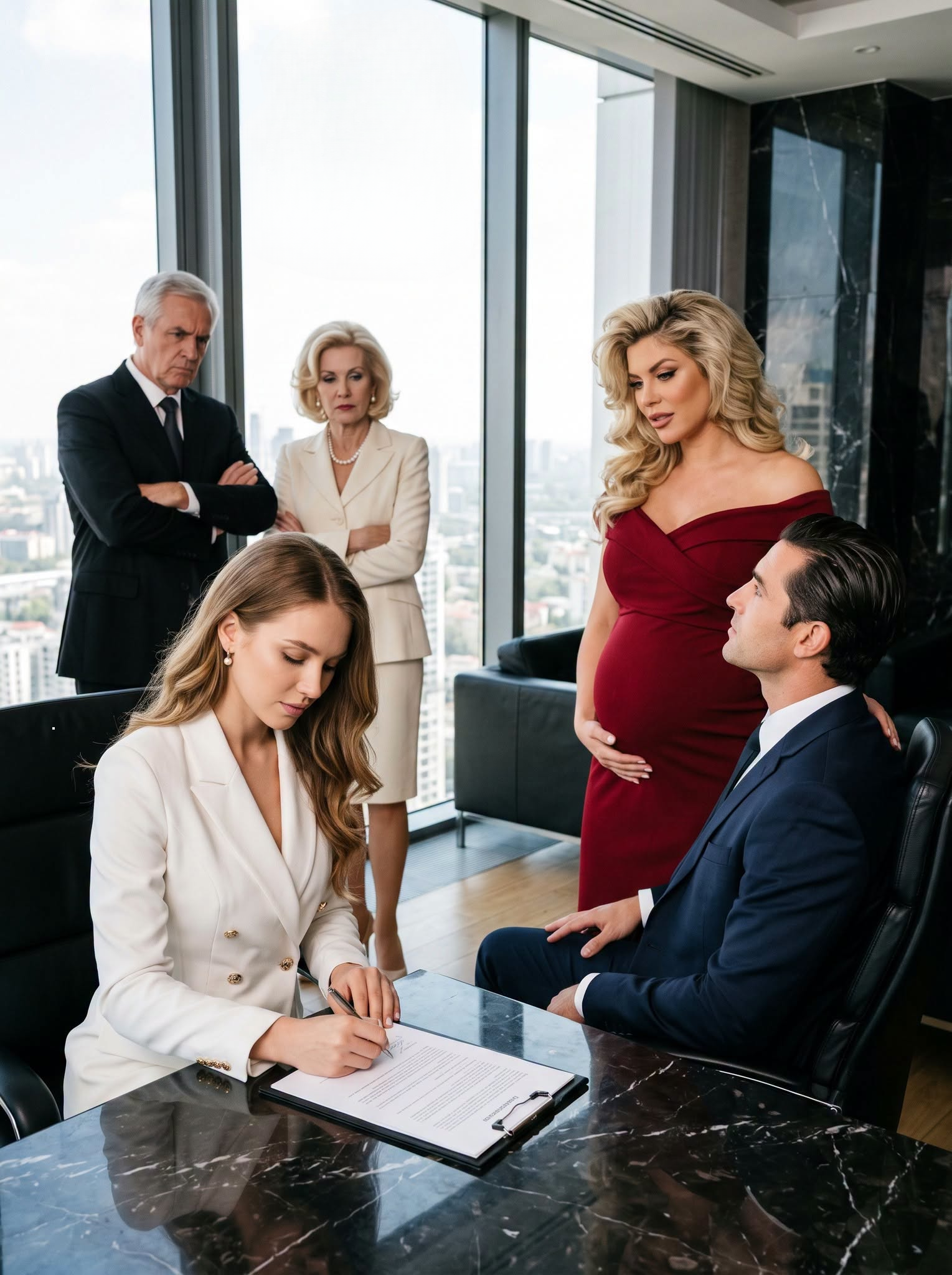
PART 1: The Cost of My Silence
“State your price, Claire. Sign today, leave quietly, and vanish before those twins arrive.”
That was how Eleanor Whitman concluded my marriage. I was seated forty-eight floors above downtown Chicago with Lake Michigan sparkling beyond the glass, while a divorce agreement lay open before me. My husband, Nathan, was across the table, alongside Sabrina Vale, his mistress, one hand resting on her barely noticeable belly and the other intertwined with his fingers.
Twins.
The Whitman heirs.
The miracle I had allegedly failed to provide him.
“This doesn’t have to be messy,” Nathan stated.
I glared at him. “It became messy when you brought her here.”
Sabrina averted her gaze, as if I had shamed her. Eleanor slid a leather folder toward me.
“Twenty-eight million dollars. The Charleston house. The Boston condo. Lifetime annuity.”
Then came the real cost.
Silence.
No public statements. No claim against Whitman Holdings. No communication with Nathan, Sabrina, or any future Whitman offspring.
One clause froze me in my tracks.
Complete disconnection from any present or future Whitman family matters.
Their lawyer labeled it standard.
I nearly chuckled.
“There is nothing standard about erasing a wife of eight years before lunch.”
Nathan’s father, Conrad, leaned in. “You had your chances, Claire. My son requires heirs.”
Heirs.
For years, I had endured injections, procedures, miscarriages, muted hospital rooms, and doctors apologizing while Nathan held my hand and insisted that children did not define us.
Then he stopped holding my hand.
Then came Sabrina.
“How far along are you?” I inquired.
“Almost twelve weeks,” she replied.
My gaze shifted to Nathan.
Ten weeks prior, he had taken me to Lake Geneva. Rain pattered against the windows. His arms were around me. His voice trembled as he whispered, “I don’t want to lose you.”
Now his mistress was nearly twelve weeks pregnant.
I picked up the gold pen.
Signed.
Page after page.
No one noticed my hands were steady.
No one questioned why I wasn’t fighting.
And no one realized that three days earlier, a private DNA report had revealed one devastating truth.
The twins were not Nathan’s.
Then my phone lit up beside my hand.
A message from a wedding planner appeared.
Below it was the DNA report.
Nathan saw the lab’s name, leaned forward, and turned pale.
“What the hell is that?”
I slowly turned my gaze to Sabrina.
For the first time that afternoon, she was not smiling.
PART 2: The Woman Who Already Knew
Nathan’s voice dropped.
“What the hell is that?”
Everyone focused on him, not me. Nathan Whitman rarely showed surprise. He had faced hostile boardrooms, failed acquisitions, and dinners where investors insulted him directly.
But now he stared at my phone as if three letters from a lab had shattered years of denial.
I turned the screen facedown.
“Nothing that belongs in this room.”
“Claire.”
For years, my name had evolved in his mouth: tender, distracted, impatient, apologetic, then formal.
This time, it sounded fearful.
I stood up and gathered my copy of the settlement.
“You wanted my signature. You have it.”
Conrad’s lawyer cleared his throat. “Mrs. Whitman, there are procedural matters—”
“My attorney can manage them.”
Eleanor frowned. “You brought an attorney?”
“Of course.”
That small wrinkle between her brows indicated how severely they had underestimated me.
They assumed I would arrive alone because I had always been the woman who remembered birthdays, sent flowers, resolved arguments, and quietly named guests at charity dinners for Nathan.
They mistook restraint for powerlessness.
“My attorney reviewed every page yesterday,” I stated. “I knew precisely what I was signing.”
Nathan stood. “You knew?”
“Yes.”
“How?”
“I received a draft.”
“From whom?”
I glanced at the lawyer, who suddenly found his notes fascinating.
Nathan’s jaw clenched.
“What laboratory was that?”
Sabrina turned to him. “Why does it matter?”
He didn’t respond.
That was the first crack.
I slipped the phone into my handbag.
“Goodbye, Nathan.”
He followed me around the table.
“What do you know?”
I scrutinized the man I had loved for eight years and finally learned how to stop loving alone.
“I know you should ask Sabrina some questions.”
Eleanor stood.
“If you’re implying something about those babies, tread carefully.”
“I spent eight years being careful, Eleanor.”
The room fell silent.
“I’m done.”
Then I exited.
PART 3: The Man Waiting Downstairs
The elevator descended forty-eight floors.
I anticipated relief, triumph, or sorrow to wash over me.
Nothing came.
Only fatigue.
When the doors opened into the marble lobby, Elliot Hayes awaited beside a stone pillar in a navy overcoat.
He glanced up from his phone and handed me a paper cup.
“Tea. Two sugars. I remembered.”
That nearly shattered me.
Elliot was forty-two, an architect with a tendency to measure rooms with his eyes while feigning attention. We had met eleven years earlier, before Nathan, when his firm restored the library where I worked.
We became friends.
Then life intervened.
He married. I married. We exchanged Christmas cards.
His wife passed away five years ago, unexpectedly, leaving him with a college-aged daughter and a silence he never knew how to articulate.
We reconnected the previous spring at a museum fundraiser. By then, Nathan and I had been leading separate lives under one roof for nearly a year.
Nothing transpired between Elliot and me then.
Not for months.
The first time he kissed me, I had already informed Nathan that I wanted a separation. Nathan requested time. I granted it to him.
Then he traveled to Europe on business and returned smelling like Sabrina’s perfume.
Elliot opened the car door.
“You signed?”
“Yes.”
“All of it?”
“All of it.”
“How do you feel?”
“Twenty-eight million dollars wealthier.”
“That wasn’t what I asked.”
I gazed out at the gray Chicago traffic.
“Like someone sold me my own freedom.”
Elliot contemplated that.
“Then perhaps the first thing you should do is stop measuring freedom by what they paid for it.”
I smiled despite myself.
“You rehearsed that.”
“Only the first half. The second half was panic.”
I chuckled.
It was small.
But it was mine.
PART 4: The Message From Sabrina
We headed north instead of returning to the townhouse.
I had ceased viewing that place as home months earlier.
Elliot took me to the lakefront, where the wind made conversation challenging. That was one reason I trusted him. He understood that silence could be generous.
My phone continued to vibrate.
Nathan.
Eleanor.
Nathan again.
Then an unknown number.
I ignored all of them.
At the end of the path, Elliot mentioned the wedding planner’s message Nathan had seen.
The ceremony was not set for next week or even next month. It was scheduled for October, a small gathering at an inn in Vermont with Elliot’s daughter, my sister Joanna, and a few individuals who knew us without needing a performance.
Elliot had proposed in January.
I declined.
Two weeks later, I called him and asked if the proposal was still available.
He said good proposals do not expire.
So I accepted.
No announcement. No hidden hotel affair. No dramatic rescue.
Just two adults who had realized that love in middle age could be quieter.
Less about escape.
More about recognition.
Then my phone buzzed again.
Sabrina.
Please talk to me before you inform Nathan about anything.
I read it twice.
Elliot noticed my expression.
“What?”
I extended the phone.
He did not take it.
“That seems personal.”
A year earlier, I might have mistaken that for indifference.
Now I recognized it as respect.
“I need to see her,” I stated.
“Do you want me nearby?”
“Yes.”
“Then I’ll be nearby.”
Sabrina selected a small café in Lincoln Park with mismatched chairs and tulips in old glass bottles.
She was already there.
No diamonds.
No perfect smile.
For the first time, she simply appeared thirty-one.
Young enough to think certain choices could wait until they became easier.
They rarely do.
PART 5: The Other Man
Sabrina cradled her cup with both hands.
“Thank you for coming.”
“You said before I informed Nathan anything.”
“Yes.”
“What do you think I know?”
“That depends on what was in the report.”
I waited.
She tightened her grip.
“You had no right to test anything.”
“That’s true.”
She blinked, as if she had anticipated denial.
I explained that an anonymous prenatal blood-screening vial had been delivered to my office. The label bore her name. I should have discarded it.
I didn’t.
The lab confirmed it was consistent with a prenatal sample and compared fetal markers against Nathan’s stored fertility DNA.
“And they said Nathan isn’t the father,” she whispered.
“They indicated the tested fetal DNA was inconsistent with paternity.”
“That proves nothing legally.”
“I know.”
“Then why did you look at me that way in the conference room?”
“Because you appeared scared before I disclosed the report’s contents.”
For several moments, neither of us spoke.
Then she murmured, “I am scared. But not for the reason you think.”
“What reason?”
“Because someone knows.”
“Knows what?”
“That Nathan may not be the father.”
The café seemed to hush around us.
Sabrina confessed there had been another man before she and Nathan became serious. The timing overlapped by ten days.
“You told Nathan the babies were his.”
“I believed they were.”
“Did you?”
She looked away.
There it was.
The distinction between a lie and a truth someone had avoided verifying.
“I wanted them to be.”
“Who is he?”
She hesitated.
“Adrian Bell Whitman.”
I slowly sat back down.
Adrian was Nathan’s cousin.
If Adrian is the father, the babies are still Whitmans.
Just not Nathan’s.
PART 6: Nathan Calls
Sabrina vowed to inform Nathan that night.
At 9:17, he called.
For several seconds, I heard only breathing.
“Did you know about Adrian?”
“Yes.”
“Since when?”
“About three hours.”
“And the report?”
“Three days.”
He exhaled.
“Sabrina told me.”
“I figured she would.”
He asked where the sample originated. I told him the truth: I did not know.
“You just tested it?”
“I made a poor decision.”
He sounded weary.
“I thought they were mine.”
I closed my eyes.
“I know.”
“No, you don’t.”
“You’re right.”
Silence stretched between us.
Then he said, “I’m sorry.”
The words felt painfully inadequate.
“I don’t know what you want me to do with that.”
“I don’t either.”
For once, he sounded almost like the man from Lake Geneva.
Almost.
“I thought if she was carrying my children,” he said, “everything else had to become straightforward.”
“And did it?”
“No.”
Neither of us softened the truth.
Then he stated, “The settlement stands.”
“That wasn’t in question.”
Another silence.
“Who is Elliot?”
I looked down at the engagement ring I wore on a chain beneath my sweater.
“A man I’m going to marry.”
Nathan inhaled.
I anticipated jealousy.
Instead, he asked, “Are you happy?”
I glanced around the guest room filled with half-packed boxes.
“I’m getting there.”
“That wasn’t what I asked.”
“I think I can be.”
Softly, he said, “Good.”
That was the closest thing to kindness we had exchanged in months.
Before ending the call, he asked, “Did you ever consider returning?”
I looked toward the bedroom we once shared.
“No.”
Gentle.
But complete.
PART 7: The Family Secret
The divorce was finalized on a Thursday.
No courtroom drama.
No photographers.
Just an email from my attorney at 10:12 a.m.
Filed and entered. You are officially divorced.
I was standing in Elliot’s garden holding tomato seeds when he found me.
“Finished?”
“Finished.”
No champagne appeared.
No dramatic proclamation.
We planted tomatoes.
That evening, Elliot’s daughter Lucy arrived with takeout and a small chocolate cake that read:
CONGRATULATIONS ON THE ADMINISTRATIVE CLARITY.
I laughed so hard I had to sit down.
For years, family dinners at the Whitman table made me tense without my realizing it. Someone always wanted something: an agreement, an appearance, a decision, a performance.
Here, the biggest controversy was whether Lucy had cheated at a board game.
I felt tranquility.
Not dramatic happiness.
Something better.
Safety without performance.
The following week, Eleanor called.
She had told Nathan something else.
His parents were O positive and A positive.
Nathan was AB positive.
Two parents without a B allele couldn’t typically have an AB child.
“Is Conrad Nathan’s father?” I inquired.
“I don’t know,” Eleanor whispered. “But after forty-one years, I think I understand why Conrad’s brother disappeared.”
PART 8: Eleanor’s Confession
Eleanor requested that I meet her at a small bakery in Evanston, not the Whitman offices.
No driver.
No pearls.
No assistant.
For the first time in fourteen years, she appeared older than her reputation.
“You mentioned Conrad’s brother disappeared,” I began.
“Richard,” she replied. “Adrian’s father.”
Then she recounted the story.
She had loved Richard first.
They were twenty-two. Conrad was stable and responsible. Richard was unpredictable, warm, and impossible to organize. When Richard left for California and asked her to come, she was afraid.
Three weeks later, she discovered she was pregnant.
“Nathan,” I said.
“Yes.”
“Richard could be his father.”
“Yes.”
“Did Conrad know?”
“I informed him before we married. He said biology didn’t matter.”
But after Nathan was born, Richard returned. Conrad asked Eleanor not to tell him. He said they had created a family, and the truth would only ruin lives.
So she remained silent.
For forty-one years.
She wanted to know if she had the right to ask Adrian for a test.
“You can ask,” I said. “But you cannot demand. And you must inform Nathan first.”
She nodded.
Then she said something I never expected.
“I owe you an apology. What happened to you and Nathan was not my decision to make.”
“No.”
“I convinced myself I was protecting the family.”
“You were protecting the image of the family.”
Her expression tightened.
“Yes.”
Forgiveness did not arrive.
But space for it did.
PART 9: What Truth Changed
Nathan and Adrian consented to testing.
Eight days later, Eleanor called.
“Richard was his father.”
The test revealed a 99.8 percent probability that Nathan and Adrian were half-brothers.
Forty-one years of uncertainty became a figure.
“How is Nathan?”
“Quiet.”
“And Conrad?”
A long pause.
“Heartbroken.”
Conrad told Nathan he had always known the day might arrive.
Nathan told him he was still his father.
Eleanor wept softly.
“I thought knowing would ruin us.”
“It didn’t,” I said.
“No. It changed us.”
“That’s different.”
Summer arrived.
The Whitmans quietly restructured themselves.
No public scandal.
No announcement.
Nathan remained Nathan Whitman. Conrad remained his father in every practical sense that mattered. Richard became part of the history, but not a substitute for the years already experienced.
Adrian stayed in Chicago through the twins’ birth.
Sabrina gave birth to two girls in September: Rose and Emilia.
Adrian did not immediately marry her.
Instead, they lived six blocks apart, started counseling, and learned how to become parents before deciding whether they could become partners again.
Nathan visited the babies once.
Eleanor informed me that he held Rose for almost an hour.
I did not inquire why.
Some things do not require interpretation.
PART 10: Open Door
My wedding occurred in October.
Twenty-seven guests.
No society photographers.
No announcement in business pages.
The inn overlooked a Vermont valley turning gold and red. That morning, Joanna fastened the pearl buttons on my dress while Eleanor’s letter sat on the table.
It was not a grand apology.
Just a few sincere lines.
Family is not safeguarded by controlling who enters or exits it. It is protected by truth-telling and allowing people to choose what they do with it.
I folded the letter.
“Ready?” Joanna asked.
“Yes.”
Elliot waited beneath an old maple tree.
Our vows were brief because we had both lived long enough to distrust extravagant promises.
He promised to tell me when he felt frightened.
I promised not to confuse independence with never needing anyone.
Then he said, “Whatever life looks like, I will not ask you to earn your place in mine.”
My eyes filled.
“I promise I’ll never remain silent just to maintain peace.”
Twenty-seven people applauded.
No empire changed hands.
Nothing collapsed.
It was perfect.
Later, I used part of the settlement to launch Open Door, a grant program for fertility treatment, counseling, foster-care exploration, and individuals creating meaningful families without children.
A year after the divorce meeting, Eleanor sent me a photo.
Rose and Emilia sat on a picnic blanket in matching yellow hats. Behind them stood Nathan and Adrian. Conrad sat nearby with one hand on Nathan’s shoulder.
The caption read:
Family lunch. No contracts required.
I laughed, typed back, They’re beautiful, and put the phone away.
Nathan had once believed twenty-eight million dollars would buy my silence.
In the end, it bought something neither of us anticipated.
Time.
Distance.
And the freedom to cease living within narratives our families crafted before we realized we could write our own.