Everyone in town believed my husband was an amazing father. I understood the reality was more intricate, but I never anticipated our seven-year-old daughter would be the one to reveal how meticulously he had crafted that persona.
My husband Richard was well-known in our town for two things: his success and being a fantastic father.
At home, the situation looked quite different. After the birth of our third child, Richard persuaded me to leave the career I had dedicated years to developing.
“The kids need you,” he claimed. “I’ll take care of everything.”
He would smile as the children unwrapped their gifts.
I trusted him because marriage was meant to be about having faith in the person beside you most.
Before long, I was preparing six lunches, arranging dental appointments, laundering uniforms, reviewing homework, signing permission slips, managing fevers, locating lost shoes, and remembering every little detail six growing children could produce.
Richard took care of gifts.
Expensive sneakers. Tablets. Bikes.
It was simpler than explaining why the man who bought the bike had no clue what size shoes its rider needed that year.
He would smile as the children unwrapped their gifts and say, “Make sure you tell Mrs. Carter Dad got you that.”
Everyone laughed.
I often laughed too.
It was easier than explaining why the man who purchased the bike had no idea what size shoes its rider actually required that year.
Richard was seldom home unless there was someone significant to impress. He showed up at school events, neighborhood barbecues, and charity dinners at just the right moments.
He missed stomach flu, reading sessions, and parent portals.
He missed regular Tuesdays.
He missed stomach flu, reading sessions, and parent portals.
The kids stopped asking when he would come home.
I noticed it before he did.
I also knew about the other women.
He would sit at our kitchen island, check his watch, and speak in a calm manner.
I discovered messages first, then hotel bills, and then a second phone he claimed belonged to an employee. When I finally confronted him, Richard did not express remorse.
He sat at our kitchen island, checked his watch, and spoke calmly.
“I’m not attracted to you anymore, Megan.”
I stared at him.
He continued, “But a divorce would be terrible for my reputation. People trust a family man.”
From that moment, I realized that my understanding of happiness had a darker aspect.
That statement lingered with me.
Not because it was harsh. Richard had uttered cruel things before.
It stayed with me because he finally articulated the marriage in terms he truly understood:
Appearances were important.
From that moment, I knew that my perception of happiness had a darker side.
Then the school announced its annual Parent of the Year award.
I began quietly updating my résumé at night, after the children were asleep. I saved copies of financial documents. I looked into the certifications I would need to re-enter the workforce.
Richard noticed none of this.
He was busy being praised by everyone else.
Then the school announced its annual Parent of the Year award.
“Do teachers ever discuss parents with the kids?”
Richard reacted differently.
He began asking odd questions.
“Do teachers ever discuss parents with the kids?” he inquired one evening.
I looked up from folding towels. “Sometimes, I suppose. Why?”
He shrugged. “Just curious.”
He would inquire about school from Lily while glancing at his phone.
A week later, he started appearing for dinner more frequently.
Not contributing, exactly.
Just appearing.
He would ask Lily about school while checking his phone, then tell Sam, “Remember our lake trip last summer? It was a great weekend.”
Sam usually replied yes, albeit confused.
Richard opened it before I returned home.
Then an envelope arrived from the school.
Richard opened it before I arrived home. He left it on the counter, face down under his keys.
I caught only the gold border.
When I asked what it was, he smiled.
“Nothing significant. Just school paperwork.”
He quickly changed the subject.
Richard informed me Thursday evening that attendance was important.
The ceremony was scheduled for Friday night.
Richard informed me Thursday evening that attendance was important.
“The principal invited us,” he said.
I inquired why.
“You’ll see.”
He sounded pleased with himself.
That was the first moment I sensed something beneath his sudden interest in the school.
Lily began bouncing in her seat. “Daddy says there’s a surprise.”
Richard shot her a glance.
She immediately fell silent.
That was the first moment I sensed something beneath his sudden interest in the school.
Still, I dressed the children, located matching socks, styled Grace’s hair, and drove separately because Richard left earlier for what he termed photographs.
Richard stood near the stage in an expensive suit, laughing with the superintendent.
The auditorium was packed. Teachers, parents, local business owners, and a local reporter filled the seats.
I sat off to the side with an empty chair next to me.
Richard stood near the stage in an expensive suit, laughing with the superintendent. People kept turning toward him and smiling warmly.
Then Mrs. Carter approached the microphone.
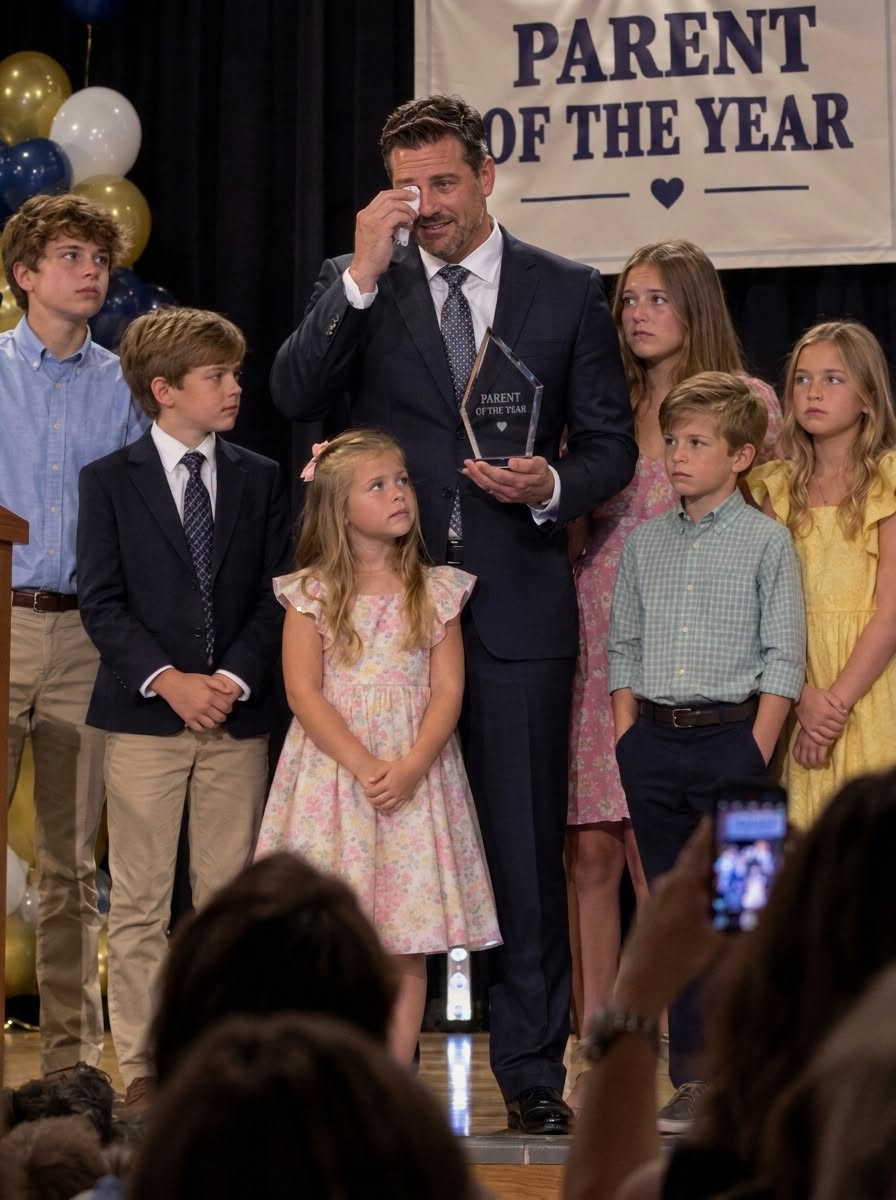
“Our Parent of the Year,” she announced, “is Richard Bennett, an exceptional father who somehow manages a demanding career while raising six wonderful children.”
He wiped his eyes as phones rose around the auditorium.
The room erupted in applause.
My husband walked onstage, grinning widely.
He wiped his eyes as phones rose throughout the auditorium.
“People often ask how I juggle it all,” he began. “Honestly, there are nights I barely sleep. Raising six children is the hardest job I’ve ever undertaken, but they’re worth every sacrifice.”
I wondered if anyone remembered those six children had a mother sitting ten rows away alone.
My stomach churned.
I wondered if anyone remembered those six children had a mother sitting ten rows away alone.
Then Richard smiled toward the wings.
“Come up here, kids.”
All six stepped onto the stage.
He embraced them one by one while phones lifted across the auditorium. Lily appeared thrilled. Grace looked uneasy.
“Of course, sweetheart. Tell everyone how much you love Daddy.”
Claire, our eldest, glanced at me instead of him.
Her expression froze me in place.
Before I could comprehend why, seven-year-old Lily tugged at Richard’s sleeve.
“Daddy, can I have the microphone? There’s one little detail.”
Richard laughed into his own microphone.
“Of course, sweetheart. Tell everyone how much you love Daddy.”
She scanned the room until she located me.
Lily took it cautiously with both tiny hands and faced the audience.
She searched the room until she found me.
Then her smile faded.
“Daddy, do I still get the bike now?”
The auditorium fell silent.
Richard crouched beside her.
Someone in the front row gasped.
“What bike, sweetheart?”
Lily frowned.
“The pink one. You said if we told Mrs. Carter you always help us, you’d get it.”
Someone in the front row gasped.
Richard straightened up.
Before anyone could react, ten-year-old Sam spoke from behind Grace.
“She misunderstood,” he said quickly.
Mrs. Carter stared at him.
Before anyone could respond, ten-year-old Sam spoke from behind Grace.
“You told me I’d get the game too.”
Richard turned sharply.
“Sam.”
The older children exchanged glances.
My son stepped back.
The older children exchanged glances.
I realized then.
Claire looked furious.
I stood.
“Kids, come with me.”
Dozens of people watched us walk into an empty classroom.
Richard started down the steps.
“Megan, let’s not overreact.”
I looked directly at him.
“Stay here for five minutes.”
For once, he complied.
Dozens of people watched us cross the hallway into an empty classroom.
“Several weeks ago, Dad mentioned he might be nominated for this award.”
I shut the door, faced my children, and kept my voice steady.
“Nobody is in trouble. I need the truth. What did Dad tell you?”
Lily looked at Sam.
Sam looked at Claire.
Claire shut her eyes.
“Several weeks ago, Dad mentioned he might be nominated for this award,” Claire began. “He said teachers sometimes ask us questions.”
“He said we shouldn’t forget all the things he did for us.”
Sam interrupted. “He didn’t tell us exactly what to say.”
Grace nodded.
“He just kept reminding us about the things he bought or trips he paid for.”
Claire looked furious now.
“He said if anyone at school asked what kind of dad he was, we shouldn’t forget all the things he did for us.”
Lily added, “He promised my bike.”
“He called me ungrateful. He said after everything he pays for, I could do one thing for him.”
Sam said, “And my game.”
Grace revealed concert tickets had been offered if she “helped people remember Dad does stuff.”
“I told him no,” Claire said. “He called me ungrateful. He said after everything he pays for, I could do one thing for him.”
Her voice trembled.
“I didn’t tell you because I thought you’d be embarrassed.”
I sat beside her.
“None of you did anything wrong. He was the adult here.”
“You never need to protect me from your father’s choices.”
Claire looked down. “I know.”
I shook my head.
“No. I should have made that clear sooner.”
Then I looked at all six children.
“None of you did anything wrong. He was the adult here.”
In the office, she explained everything herself.
On Monday morning, I requested a meeting with Mrs. Carter.
Claire asked to accompany me.
In the office, she explained everything herself.
Mrs. Carter looked unwell.
“During the nomination process, teachers asked several of the children informal questions about their parents,” she stated. “Some of their responses were included in the nomination file. Richard also submitted a statement detailing his involvement with school events, fundraisers, and homework at home.”
“Several community members supported the nomination.”
She paused.
“I found some of those claims peculiar.”
“Because you’ve never seen him,” I said.
She sighed. “Rarely. But Richard is well-known. Several community members supported the nomination, and having six children made his involvement seem credible.”
“I’m not asking you to give the award to me.”
I inquired how much the school had verified.
Her expression answered for her.
“Not enough,” she said quietly.
“I’m not asking you to give the award to me,” I said. “I don’t want another ceremony or another public spectacle. I just don’t want the school knowingly keeping a false award in place.”
The school had compared Richard’s claims with attendance records.
Mrs. Carter nodded.
“We’ll investigate this immediately. I’ll speak with the teachers who contributed to the nomination and review what Richard submitted.”
Two days later, Mrs. Carter called.
The school had compared Richard’s claims with attendance records, volunteer lists, and statements from the teachers who actually worked with our children. Several aspects he presented as regular involvement could not be confirmed. Combined with what the children had described, the decision was unanimous.
His name and speech were removed from the website.
Then she said the words Richard would have disliked most.
“We’re withdrawing the award.”
His name and speech were removed from the website, and the school began reviewing the entire nomination process.
By the end of the week, a brief correction had been posted explaining that the award had been withdrawn and that future nominees would require teacher input and documented participation.
For years, Richard had cared about being recognized as a family man.
That Wednesday evening, Richard entered the kitchen fuming.
Now there was no award, no speech, and no school page declaring him one.
That Wednesday evening, Richard entered the kitchen fuming.
“You ruined something that meant a lot to me.”
“Why did it matter so much?”
For once, Richard did not have a polished answer on hand.
He sat down.
“That became more important than actually being one.”
“My father barely noticed me,” he said. “I promised myself my kids would think I was different.”
His shoulders slumped.
“Somewhere along the way, people thinking I’m a good father became enough for me.”
“Yeah,” I replied. “That became more important than actually being one.”
Richard stared at the floor.
I did not offer him comfort.
“Becoming a better father doesn’t erase what you’ve done to me.”
“The kids don’t need another bike. They need you to know them.”
He nodded once.
“What do I do?”
“Start showing up when no one is watching.”
Then I put the knife down.
“But understand something. Becoming a better father doesn’t erase what you’ve done to me, and it doesn’t guarantee that we’re staying married.”
In the ensuing weeks, I stopped managing every aspect of his relationship with the children for him.
He looked up.
“This isn’t a deal, Richard. You don’t earn my affection by taking the kids to school. They’re your children. You should know them whether I stay or go.”
For once, he didn’t argue.
In the ensuing weeks, I stopped managing every aspect of his relationship with the children for him.
I observed what he did when no one was cheering.
Tuesday and Thursday school runs became his responsibility. So did Sam’s music lesson, Lily’s reading homework, two dinners each week, and some of the appointments he had long assumed I would manage.
I wasn’t sure if Richard was changing or simply learning a new way to appear convincing.
So I ceased evaluating him by speeches.
I observed what he did when no one applauded.
Worse, he drove Sam to piano lessons and discovered our son had switched to trumpet months ago.
Reality set in quickly.
The first grocery run included foods nobody enjoyed and three jars of pasta sauce without any pasta.
He forgot Lily disliked tomatoes.
Worse, he drove Sam to piano lessons and discovered our son had switched to trumpet months ago.
I could have relished embarrassing him.
Richard stared at me afterward.
“I told everyone he played piano.”
“Exactly,” I said.
I could have relished embarrassing him.
Mostly, I felt exhausted.
But something beneficial had occurred:
For the first time, Richard could no longer confuse providing for his children’s lives with truly knowing them.
Then Richard halted himself.
One evening, I passed Lily’s room and heard her struggle with the same word during reading practice.
Richard snapped, “Focus.”
Lily fell silent.
Then Richard halted himself.
There was a pause.
Nobody was taking pictures.
His voice returned softer.
“Sorry. Let’s try it again.”
She did.
He remained.
Nobody was taking pictures.
I continued walking.
A month later, I completed the first certification needed to return to my career.
That moment did not resolve our marriage.
It wasn’t meant to.
I continued working on my own future as well.
A month later, I completed the first certification required to return to my profession.
I printed the confirmation email after the kids were asleep and gazed at my name at the top longer than I anticipated.
It was a small achievement compared to everything I had once created.
My future would not rely on Richard.
But it was mine.
I updated my résumé again, opened a bank account in my name, and made one thing clear:
My future would not rely on Richard.
Months later, the Parent of the Year award had become something we hardly ever mentioned.
I didn’t know where Richard had placed the plaque.
I never inquired.
Richard entered the door carrying groceries.
What mattered more was what transpired one ordinary Tuesday evening.
Richard came through the door with groceries while Lily trailed behind him, speaking so rapidly I could barely catch her words.
“Tell Mom,” she urged.
Richard set the bags down.
“She got full marks on her spelling test.”
Lily beamed.
“And what’s my favorite color?”
Then she narrowed her gaze at him.
“And what’s my favorite color?”
He sighed.
“Pink.”
“My best friend’s name?”
“Evie.”
I observed from the kitchen.
“What book are we reading?”
He answered that as well.
Lily appeared content.
I observed from the kitchen.
There was no auditorium.
For once, nobody in town was watching.
No microphone.
No reporter.
No award.
For once, nobody in town was watching.
Just six children who knew whether he was being truthful.