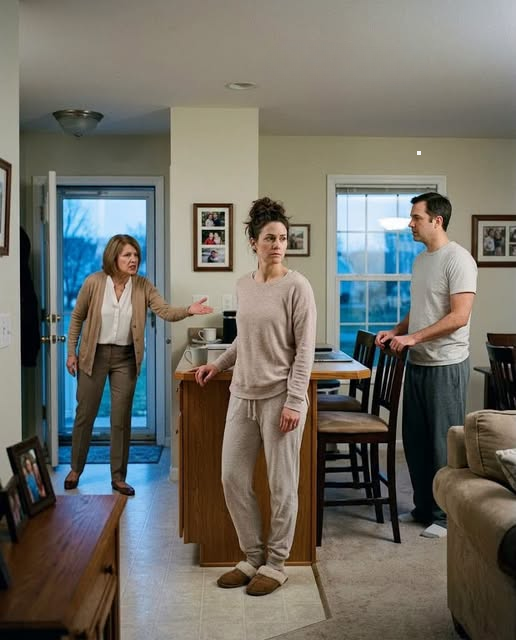
Marcus turned the document toward his mother slowly, and for the first time that morning, Beatrice ceased to act as if the money was already hers.
She had been hovering over his shoulder, impatient enough to tap the dining table while he read, but now her hand remained still beside the folder.
I sat across from them with my purse still draped over one shoulder.
Just moments earlier, they had been discussing my inheritance as if the decision was already finalized.
Now Marcus was finally reading what I had actually placed before him.
That distinction mattered.
The morning had commenced before most would have considered it morning at all.
At six, my house should have been silent.
Instead, my bedroom door had burst open forcefully enough to startle me, and Beatrice entered without knocking.
That part was not unusual.
My mother-in-law had always viewed boundaries as inconveniences others created to complicate her life.
What was unusual was the demand that came from her lips.
“Where is it?” she asked.
I was still trying to comprehend why she was standing in my house at that hour when she continued.
“The money from your mother’s apartment. We need those 8 million dollars.”
For a moment, I thought fatigue had made me mishear her.
I had returned from New York City only a few hours prior after completing the final paperwork related to my mother’s Upper West Side condo.
The bank folder was still in my grasp.
My purse remained over my shoulder.
I had scarcely had time to return home, let alone decide what I wanted to do with anything connected to the sale.
But evidently, Beatrice had already made that decision for me.
“I’m sorry,” I replied. “What did you say?”
Before she could reiterate, Marcus appeared at the bottom of the stairs.
The moment I glanced at my husband, the entire conversation shifted.
Not because he said anything dramatic.
But because he didn’t appear surprised.
He didn’t inquire what his mother was referring to.
He didn’t look bewildered about why she was in our home demanding money before dawn.
He was aware.
“Camila,” he said cautiously. “Maybe you should sit down.”
That was when I realized this wasn’t Beatrice merely presenting another one of her opinions.
This had been discussed.
Planned.
Agreed upon.
Just not with me.
Beatrice dismissed him with a wave.
“No. She needs to hear it plainly.”
I looked from her to him.
“Hear what?”
Marcus rubbed his forehead before responding.
“Mom and I were talking, and we believe that money should be used to assist Sebastian.”
His younger brother’s name landed exactly where I anticipated it.
“Assist Sebastian?”
“With his debts.”
Of course.
Sebastian had spent years creating crises and labeling them bad luck.
There had been failed businesses.
There had been reckless investments.
There had been sports betting.
There had been borrowed funds and promises about fresh starts.
At family dinners, someone always seemed to explain why this time was different.
This time, Sebastian understood.
This time, Sebastian had learned.
This time, Sebastian only needed one more opportunity.
And each time the consequences arrived, someone else was expected to make them vanish.
Evidently, the latest rescue plan involved my mother’s estate.
Beatrice stepped closer to me.
“He’s family,” she said. “Your mother would have wanted that money to remain in the family.”
The absurdity of that statement nearly made me laugh.
My mother barely knew Sebastian.
She had not spent her life sacrificing so my husband’s younger brother could continue making financial blunders without facing them.
She had spent her life surviving.
My father vanished when I was young, and after that, my mother managed everything alone.
Rent.
Food.
School expenses.
Every unexpected bill that arrived in the mailbox.
She worked overnight shifts because that was what had to be done.
She missed birthdays because bills didn’t care what day it was.
She returned home exhausted and still ensured I had what I needed.
The apartment Beatrice was reducing to an eight-million-dollar figure had been part of that life.
It had held my mother’s clothes.
Her dishes.
Her photographs.
The small items she saved because discarding them felt wasteful.
For six months after she passed, I had been the one sorting through those rooms.
I packed boxes by myself.
I opened drawers alone.
I managed appointments, filings, attorney fees, and every miserable practical detail that follows grief when the world expects paperwork to keep moving.
Some weekends I would stand in the apartment holding one of her sweaters longer than I intended because it still smelled faintly of her.
Marcus was aware of how difficult that was.
He just had not assisted.
Sebastian hadn’t helped either.
Neither had spent a Saturday sorting through decades of someone else’s life and deciding what could be kept and what needed to go.
Neither had sat with the strange guilt of selling a place that still felt inhabited by memories.
Yet somehow, Marcus and Beatrice had found plenty of time to discuss what should happen to the proceeds.
“My mother barely knew Sebastian,” I stated.
Marcus’s expression tightened.
“This is not the time to be selfish.”
That word lingered with me.
Selfish.
It would have been easy to start yelling then.
Perhaps that was what they anticipated.
Maybe they expected grief, anger, tears, and eventually exhaustion.
Maybe they believed that if they framed the decision as something already settled, I would eventually yield simply because opposing three people at once was harder than giving in.
Instead, I posed the question I needed answered.
“So you’re telling me that you already decided what happens to my inheritance?”
Marcus paused.
It was brief.
But I noticed it.
Then he replied, “I already promised Sebastian we’d assist him.”
That sentence conveyed more to me than the demand for money had.
He had made a promise using something that belonged to me.
Not discussed.
Not requested.
Promised.
“We?” I questioned.
Beatrice replied before Marcus could.
“You’re married. What’s yours is your husband’s.”
She said it with the certainty of someone repeating a rule she believed concluded the conversation.
I looked at Marcus.
He didn’t correct her.
He didn’t tell her she was overstepping.
He didn’t say the inheritance was mine to decide.
He merely stood there.
And oddly, that was when I stopped feeling cornered.
Something within me became very calm.
For six months, grief had forced me to pay attention to details I once would have avoided.
Paperwork had become unavoidable.
Questions had become unavoidable.
Every signature, every appointment, every document related to my mother’s estate had required me to think carefully before I acted.
Marcus and Beatrice seemed to interpret that quietness as weakness.
They saw a grieving woman and assumed she would be easier to pressure.
They saw money and assumed marriage granted them a vote.
They saw Sebastian’s debts and assumed I would become the next person responsible for resolving them.
So I ceased trying to explain myself.
I placed the bank folder on the dining room table.
Marcus observed it land between us.
Beatrice did too.
Then I looked directly at my husband.
“You know what?” I said softly. “You’re right.”
His shoulders relaxed immediately.
That reaction hurt more than I anticipated.
It indicated he had been awaiting surrender, not understanding.
Beatrice’s mouth curved into a small, satisfied smile.
She believed the argument was over.
For her, the story had a straightforward conclusion.
I would grant Marcus access to the money.
Marcus would fulfill his promise to Sebastian.
Sebastian’s debts would vanish.
And everyone would call it helping family.
No one would need to state aloud whose loss had covered the bill.
I let them relish that version for a few more seconds.
Then I touched the folder.
“Actually,” I said, “I have a surprise for both of you.”
Marcus reached for it.
I did not pull it away.
I slid the folder directly into his hands.
He took it with the confidence of a man who believed possession of the papers meant possession of the solution.
Beatrice pulled a chair closer and leaned toward him.
She scrutinized each page as if she were waiting for directions on how quickly the money could be moved.
I remained standing.
That mattered too.
For the first time since she entered my house, nobody was instructing me to sit down.
Marcus opened the folder.
He glanced at the first page.
Then the second.
The confidence on his face did not vanish in some dramatic moment.
It shifted more gradually than that.
His eyes ceased moving so quickly.
His focus sharpened.
He returned to something he had already read.
Beatrice noticed before I spoke.
“Well?” she inquired.
Marcus didn’t respond.
She leaned even closer over his shoulder.
“Marcus?”
Still nothing.
I had not concealed the sale from either of them.
They knew my mother’s condo had been sold.
They were aware of the amount.
There had been no secret regarding those basic facts.
The error they made was believing those were the only facts that mattered.
While they had apparently been discussing Sebastian, I had been managing the reality of my mother’s estate one document at a time.
They saw the final sale price.
I saw six months of responsibilities.
They saw a number large enough to erase someone else’s debt.
I saw the final financial chapter of my mother’s life.
Marcus moved to another page.
Beatrice tapped one finger against the table.
Her impatience returned because she still did not understand why he had stopped talking.
“What is it?” she asked.
He continued reading.
For someone who had entered the conversation proclaiming decisions, Marcus suddenly seemed very engaged in details.
I observed him without assisting.
He had not sought my help when he promised Sebastian my inheritance.
He had not sought my opinion when he and his mother decided what my mother would supposedly have wanted.
Now he could read for himself.
The room appeared ordinary around us.
The dining table was the same table where we had shared countless dinners.
The stairs were the same stairs Marcus had descended only minutes earlier.
My purse still hung awkwardly from my shoulder because I had never even finished settling in after the trip.
Nothing around us resembled the setting for a marriage-altering conversation.
Perhaps that was why it felt so intense.
Major betrayals do not always arrive with dramatic scenery.
Sometimes they occur in the room where you drink coffee.
Sometimes they happen before dawn.
Sometimes they sound like your husband saying, “I already promised.”
Marcus reread the first page.
Then he shifted the papers in his hands.
Beatrice leaned closer, trying to see around his fingers.
I could tell she was becoming irritated with him now.
She had come ready to confront me.
She had not arrived prepared to wait while her son uncovered something she did not know.
That was the first real shift of the morning.
Not because I had raised my voice.
I hadn’t.
Not because I had accused either of them of anything new.
I hadn’t.
The shift occurred because Marcus was no longer discussing what he and Beatrice had agreed upon.
He was reading.
And reading compelled him to confront something their private family meeting had entirely skipped.
Me.
My mother’s estate.
The actual documents.
The distinction between assuming control and having it.
Beatrice finally reached for the page.
Marcus moved it slightly before she could take it.
It was a subtle motion, but I noticed it.
For most of the morning, the two of them had acted like a single side of the table.
Now, for the first time, Marcus was processing something before allowing his mother to control the interpretation.
I said nothing.
I had already spent too much of my marriage explaining concepts that should not have required explanation.
Why boundaries mattered.
Why Sebastian’s crises did not automatically become ours.
Why my mother’s death was not an opportunity.
Why grief did not erase my right to make choices.
I was finished doing the emotional labor of making an obvious truth sound palatable to those who benefited from misunderstanding it.
Marcus lifted the top document slightly.
His eyes returned to the first line.
Then they moved down the page again.
Beatrice’s finger ceased tapping.
The room was not silent because anyone had been defeated.
It was quiet because, at last, the assumptions were being replaced by information.
That distinction was sufficient for me.
Six months earlier, I would not have envisioned myself standing there calmly while my husband and his mother examined documents related to the most painful period of my life.
I would not have imagined being able to let someone misinterpret my silence without rushing to defend myself.
But grief had altered the speed at which I reacted.
It had taught me that not every moment required an immediate response.
Some matters needed to be handled cautiously.
Some things needed to be documented.
Some things needed to be concluded before they were discussed.
And sometimes the most crucial thing you can do is let another person keep talking until they reveal precisely what they believe they are entitled to.
Marcus had done that.
Beatrice had done that.
Neither could later claim the conversation had been a misunderstanding.
Beatrice had demanded the money.
Marcus had admitted promising it to Sebastian.
He had labeled my resistance selfish.
His mother had informed me that what was mine was automatically his.
Those words were now part of the morning whether they liked it or not.
I did not require a louder confrontation to grasp what had transpired.
The folder had merely changed who was compelled to listen.
Marcus finally lifted the first document completely off the stack.
He reread the opening line once more.
Beatrice attempted to angle herself closer.
Then Marcus turned the page toward her.
Not toward me.
Toward her.
The same woman who had entered my house before dawn demanding eight million dollars now had to examine the information her son had just uncovered.
I observed her eyes drop to the page.
I watched Marcus keep his hand on the edge of the document.
And I recalled the expressions on both of their faces when I had stated, “You’re right.”
They had believed those two words indicated I was capitulating.
They had never considered another possibility.
I had not acquiesced to their plan.
I had only ceased interrupting it long enough for them to demonstrate exactly how far they were willing to go.
Now the folder lay open between us, and for the first time that morning, the next move was not something Marcus and Beatrice had already decided in a conversation I was never invited to.