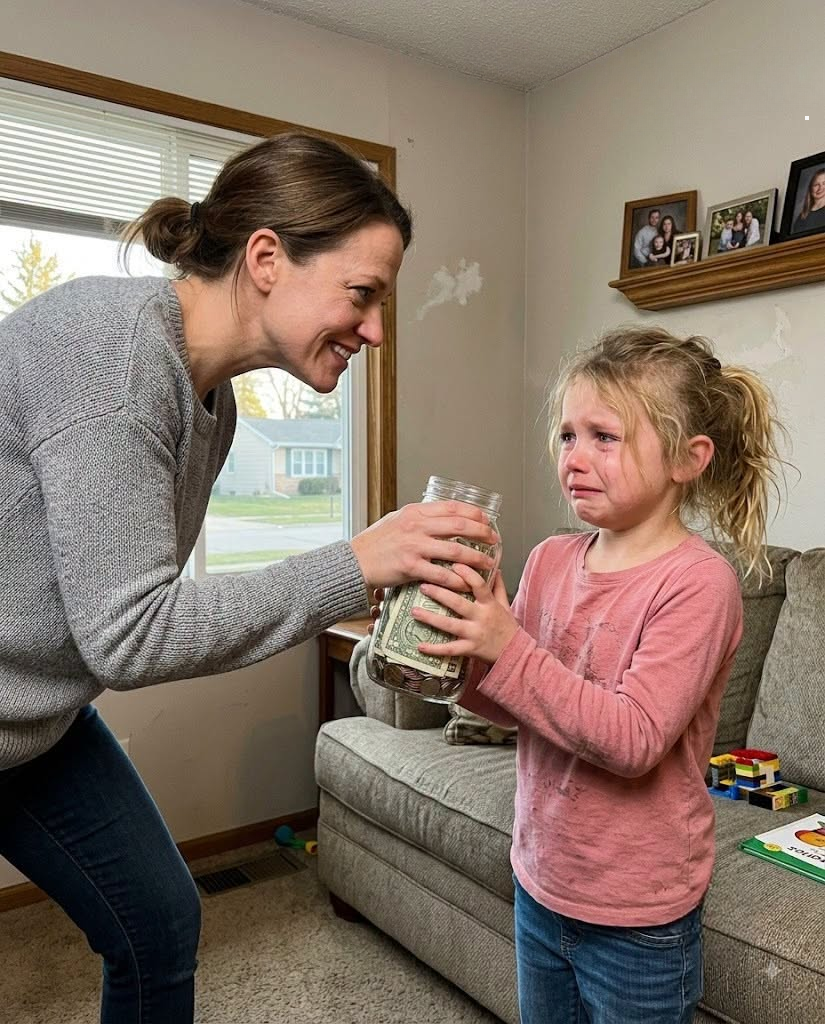
My thumb pressed the arrow, and the message was sent from my phone.
On the other end of that message was my sister Trisha, anticipating my assistance with the tuition account she believed would take her to an acting program in London.
On my end was a yellow sticky note with two figures written on it.
$1,651.26.
$40,000.
The first figure belonged to my seven-year-old daughter, Hannah.
The second was money I had spent years stretching, borrowing, and saving because somewhere along the line, my family had concluded that Trisha’s dream was also my obligation.
Up until that evening, I had gone along with it.
Then Hannah revealed what my sister had done.
And everything shifted.
A few hours prior, Trisha had been grinning in our parents’ backyard as if she had resolved every issue she had ever called me about in tears.
Charcoal smoke wafted from the barbecue while children dashed through the sprinkler, shrieking whenever the cold water sprayed their way.
My parents had folding chairs scattered across the lawn, juice boxes sweating in a cooler, and paper plates piled next to bowls of food people had brought to share.
Trisha had added something else to the gathering.
Shopping bags.
A considerable number of them.
Shiny bags with vibrant tissue paper protruding from the tops crowded one end of the folding table, as if someone had stopped at multiple stores en route and turned a family cookout into Christmas morning.
Her son Logan received new sneakers.
Her daughter Stella got something sparkly that made her squeal before she had even finished pulling it from the bag.
There were ribbons, boxes, tags, and the kind of barely concealed price stickers people usually remove when they don’t want anyone to think about what something cost.
My mother was overjoyed.
My father clapped Trisha on the shoulder.
“We’re so proud,” Mom said.
That statement irked me immediately.
Not because I was against my niece and nephew receiving gifts.
Not because I sought credit for anything.
Not because I anticipated Trisha to clarify her financial situation to me.
Because just a month earlier, she had been sitting in a grocery store parking lot sobbing on the phone because her card had been declined.
She had been attempting to purchase milk, cereal, and chicken thighs.
Nothing extravagant.
Nothing optional.
Just groceries.
Neil, my husband, had driven over with cash while I stayed home preparing Hannah’s school lunch for the next day.
That was how things typically worked with Trisha.
Something went awry, and someone in the family intervened.
More often than not, that someone was me.
Neil leaned closer while Trisha unwrapped another bag.
“Since when can she afford all this?”
“Good question.”
I said it softly because I didn’t want to turn the barbecue into a financial examination.
There were children running around, my parents were joyous, and Trisha looked pleased with herself.
Then she approached us carrying a wrapped gift.
She handed it directly to Hannah.
“Something for my niece,” she announced.
Hannah did not smile.
She did not reach for the ribbon.
She did not inquire about what was inside.
She merely stared at the package after Trisha placed it in her hands.
I noticed because Hannah typically loved surprises, even small ones.
A new set of markers could excite her.
A quirky pair of socks could do the trick.
If someone wrapped something for her, she usually wanted to know what it was before the tape had fully settled.
This time, nothing.
“Go ahead, sweetheart,” I encouraged her. “Open it.”
She shook her head.
Trisha had already moved on.
She handed our parents an envelope and declared that she had treated them to a spa day.
Mom looked delighted again.
Dad appeared impressed.
Then Trisha turned back to me.
“And Andrea,” she said. “What did you bring?”
I stared at her because for a moment I genuinely thought she was joking.
I had brought precisely what my parents had requested: pasta salad, juice boxes, sunscreen, and folding chairs.
More importantly, Trisha herself had called me two days earlier and told me not to bring gifts.
I had complied.
Now she was standing before everyone acting as though I had arrived empty-handed while she had generously taken care of the entire family.
Someone behind us murmured, “Isn’t Andrea the one who helps her out?”
Trisha kept grinning.
Too hard.
I could have confronted her.
I could have reminded everyone about the grocery store parking lot.
I could have listed the instances when Neil and I had stepped in when something came up.
I could have asked how many of those shopping bags had been purchased after a card had been declined just weeks earlier.
I didn’t.
My focus had shifted to Hannah.
Her fingers were gripping the wrapping paper so tightly that pale half-moons formed at the tips.
Logan and Stella dashed by with their new items.
Hannah never glanced at them.
She never opened her gift either.
A few minutes later, she slipped into the house.
I followed her.
The den was quieter than the backyard, although I could still hear muffled voices through the walls and the occasional burst of laughter from outside.
Hannah had curled herself into the corner of the couch.
The unopened package sat across her knees.
I sat beside her.
“Baby, what’s wrong?”
Her chin began to tremble.
“I don’t want this.”
“Why?”
She looked down at the package.
“It’s for Stella.”
At first, I thought she meant Trisha had mixed up the gifts.
That would have been odd, but fixable.
Then Hannah’s voice dropped so softly I almost missed the next sentence.
“I just want my jar back.”
That was the moment the entire barbecue shifted for me.
A few days earlier, Neil and I had helped Hannah count the money in that jar.
She carried it around like treasure because, to her, it was treasure.
The total was $1,651.26.
I remembered the exact amount because Neil had noted it on a sticky note and tucked it beneath the lid after we counted everything together.
There were birthday bills folded into tiny squares.
There was Christmas money.
There were five-dollar rewards Hannah had earned helping neighbors pull weeds.
There were small envelopes from her grandparents.
None of it had come all at once.
She had saved slowly.
She had saved proudly.
She had saved because we had taught her that money set aside for later was something worth safeguarding.
Then my sister saw it.
Hannah told me Trisha had asked to see the jar.
She had noticed Neil’s sticky note beneath the lid.
$1,651.26.
Trisha told Hannah that Logan and Stella didn’t have anything like that.
She said good kids helped family.
Hannah said no.
That should have ended it.
A seven-year-old shouldn’t need a financial argument prepared when an adult asks for her savings.
A child saying no should have sufficed.
Instead, my grown sister leaned over my daughter and told her, “Hand it over, or everyone will know you’re a selfish little brat.”
Hannah gave her the jar.
Of course she did.
She was seven.
Trisha was her aunt.
She was an adult Hannah had been taught to trust.
And Trisha had turned that trust against her by convincing a little girl that safeguarding her own money meant she was selfish.
I held Hannah while she sobbed into my shirt.
There are moments when anger feels loud before you ever make a sound.
I could picture the backyard clearly from where I sat.
The bags.
The sneakers.
The glittery gift.
The envelope for my parents.
The praise.
My sister had stood there receiving accolades for generosity funded, at least in part, by money she had pressured out of a seven-year-old.
I wanted to walk straight outside with Hannah’s story in my mouth.
I wanted everyone who had admired Trisha’s shopping bags to hear where the money had originated.
I wanted my mother to view those gifts differently.
I wanted my father to remove his hand from Trisha’s shoulder.
But Hannah had already been turned into part of Trisha’s act once.
I wasn’t going to drag her outside and make her pain the next spectacle.
So I remained with my daughter until she could breathe without trembling.
Then I returned to the yard.
Neil was standing next to the cooler.
I glanced at him.
That was enough.
He stood up immediately.
At 6:42 p.m., we buckled Hannah into the backseat and departed from my parents’ house.
We didn’t create a scene in the driveway.
We didn’t announce why we were leaving.
We simply took our daughter home.
Later, Hannah managed half a grilled cheese.
Her eyes were puffy from crying.
Eventually, she fell asleep.
At 7:18 p.m., I sat down at the kitchen table and opened my laptop.
That was when I looked at the other sum of money connected to Trisha.
$40,000.
It wasn’t hers.
That distinction mattered more than it ever had before.
The funds sat in an account I had built through years of saving, stretching, rearranging, and borrowing.
It was allocated for Trisha’s acting program in London.
Tuition.
Housing.
Travel.
Her dream.
Over time, my family had discussed that dream so frequently that the language surrounding it had shifted without me realizing.
What began as help had started sounding like an obligation.
What I had chosen to provide had gradually become something Trisha expected to receive.
Somewhere in that process, access had begun to feel like ownership to her.
But the account was mine.
The bank portal bore my name.
The tuition authorization carried my name.
The routing confirmation contained my information.
Every receipt Neil had scanned, dated, and filed bore my signature.
Those details had always seemed mundane before that night.
Now they felt enlightening.
I kept hearing Hannah’s voice.
She wanted to know, in the way children ask questions even when they don’t voice them directly, whether saving money made her selfish.
She had spent years putting away small amounts because her parents told her saving was responsible.
Then one trusted adult had taken that lesson, twisted it, and punished her for believing it.
I couldn’t teach Hannah to safeguard what belonged to her and then model the opposite with Trisha.
I opened the transfer page.
My hands were steady.
That surprised me more than anything.
I was angry, but this didn’t feel impulsive.
It felt deliberate.
The tuition money left the account Trisha expected to use.
Nothing about Hannah’s savings had suddenly been remedied by that transfer.
Her jar was still gone.
Her money had still been taken.
The words Trisha had used on her had still been spoken.
But one assumption had ended.
My sister no longer had automatic access to funds simply because my family had gotten used to me providing it.
At 9:51 p.m., my phone illuminated beside the laptop.
It was Trisha.
Her message was casual enough to indicate she didn’t yet grasp what had changed.
“Hey. Can you transfer? Something’s wrong with the tuition account.”
I stared at the screen.
Three hours earlier, she had been at a barbecue distributing gifts and accepting praise.
Now she was reaching out to me because the much larger sum she expected from me was suddenly unavailable.
I did not call her.
I opened the folder Neil had created for the tuition records.
Receipts were organized by date.
Routing confirmations were present.
Authorizations were there.
It was an ordinary stack of financial paperwork, but it made one fact impossible to obscure: aiding Trisha had always been my choice.
I took a yellow sticky note.
I wrote $1,651.26.
Then I wrote $40,000 beneath it.
I placed the note beneath my laptop screen.
Two figures.
Two very different individuals.
One belonged to a seven-year-old who had saved birthday money, Christmas bills, and five-dollar rewards because she believed adults when they told her saving mattered.
The other represented support for a grown woman who had become so accustomed to receiving my help that she seemed to think the assistance itself belonged to her.
Trisha’s message remained on my phone.
She wanted to know what was wrong with the tuition account.
Nothing was wrong with it.
That was the point.
The account was functioning precisely as an account in my name should function.
The person who controlled it had made a decision.
I contemplated everything I could have written.
I could have labeled her a thief.
I could have told her she had embarrassed herself at the barbecue without even realizing it.
I could have threatened to inform Mom and Dad exactly where Hannah’s money had gone.
I could have listed every instance when Neil and I had helped her.
I could have turned the message into years of resentment.
I didn’t.
This was about Hannah first.
So I kept it there.
Before London could be discussed, Hannah’s entire $1,651.26 needed to be returned.
And Trisha needed to explain directly to Hannah why she had taken it.
No performance.
No family audience.
No attempt to transform generosity into a defense.
Just the money returned and the truth conveyed to the child who had been coerced into surrendering it.
I did not threaten her with humiliation.
I did not mention the shopping bags.
I did not tell her what Mom or Dad might think.
I gave her one clear starting point to begin mending what she had done.
Then I sent the message.
The most significant aspect of that moment was not the $40,000.
It was the distinction between help and entitlement.
For years, I had treated assisting Trisha as something loving people did when family was in need.
That did not make every future dollar hers.
It did not make my daughter’s savings hers.
And it did not make Hannah selfish for saying no.
That was the lesson I wanted my daughter to witness, even if she was asleep down the hall while I finally acted on it.
Saving something does not mean you owe it to the first person who demands it.
Helping family does not necessitate surrendering every boundary.
And generosity ceases to be generosity when someone decides they are entitled to take it from you.
My phone was still in my hand.
The records were still open on the laptop.
The yellow sticky note remained beneath the screen with $1,651.26 written above $40,000.
One figure had belonged to a child who was too young to defend herself against an adult she trusted.
The other was controlled by an adult who finally realized that saying yes for years did not nullify her right to say no once.
The message had gone through.
What Trisha chose to do with that boundary would be her decision.