My father lowered his voice and informed me that the locked door was about something entirely different.
I halted my breathing for a moment.
In the hospital room, my husband was observing me with a concentration that made it clear he was hearing enough of the discussion to realize this was escalating.
My mother continued to hold my father’s phone.
She called his name sharply, as if issuing a warning.
Yet he persisted in speaking.
“She wanted you to return.”
I fixed my gaze on the wall ahead.
“What?”
My father swallowed hard enough for me to hear it through the phone.
“Your mother believed that if we declined to take the girls, you would have no option but to turn back and return.”
For a brief moment, I genuinely thought I had misinterpreted him.
Return where?
To their home?
On Christmas night, while my husband lay in a hospital bed?
My mother immediately interjected.
“That is not what I said.”
Before I could respond, my father replied to her.
“You said she needed to stop prioritizing him.”
My husband’s eyes met mine.
There it was.
Not babysitting.
Not a confusion over whether I had called beforehand.
Not some absurd dispute about boundaries or being taken for granted.
My mother had concluded that my husband’s hospitalization was yet another competition she was weary of losing.
I struggled to articulate the next words.
“You knew why I was leaving them there.”
My mother exhaled.
“I knew what your daughter said.”
“What did she say?”
She remained silent.
I pressed again.
“What did my eight-year-old say to you at the door?”
My father responded instead.
“She said her daddy was in the hospital and you needed to get back to him.”
Something within me froze completely.
She was aware.
She knew my husband was in the hospital.
She knew my daughters thought they were being left somewhere secure.
She understood my eight-year-old did not know how to return home.
And she closed the door anyway.
My mother attempted to interject.
“I thought you were still close by.”
“You saw my car leave.”
Silence.
My father quietly acknowledged, “I did.”
I glanced through the open doorway of the hospital room toward the hallway.
One of my daughters was down there under warmed blankets because two adults had chosen a family emergency as the perfect moment to teach me a lesson.
My husband extended his hand once more.
This time I handed him the phone.
He didn’t raise his voice.
That made it almost worse.
“Did either of you go after them?” he inquired.
My father was the first to respond.
“No.”
“Did either of you call my wife?”
Another pause.
“No.”
“Did either of you ensure those girls had a safe place to go?”
My mother snapped, “We assumed she would return.”
My husband looked at me, then toward the hallway.
“You thought an eight-year-old would resolve your argument for you.”
My mother began to protest that it wasn’t fair.
He ended the call.
Not in a dramatic manner.
Not with a speech.
He simply returned my phone to me and pressed the red button with his thumb.
Then he reclined against his pillow, closed his eyes, and said, “Go sit with them.”
I did.
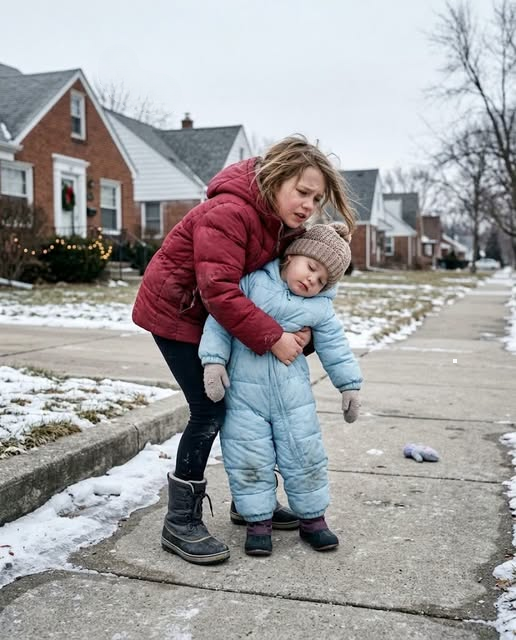
My older daughter was awake when I arrived back.
Her little sister was sleeping nearby, bundled so tightly that only part of her face was visible.
The eight-year-old appeared smaller than she had that morning.
Not younger, precisely.
Just weary in a manner no child should feel on Christmas.
Her fingers were still grasping the edge of the blanket.
I pulled a chair closer.
She looked at me and immediately asked, “Is Daddy mad?”
That question impacted me more than anything my parents had said.
“At you? No. Never.”
She nodded, but continued to scrutinize my face.
I realized she was examining me in the same way children observe adults when trying to determine which version of the truth is safe enough to accept.
So I didn’t give her a lecture.
I just moved my chair nearer until my knee brushed against the side of her bed.
“You did exactly what you could,” I said. “You stayed with your sister. You remembered my number. You got help.”
Her eyes welled with tears.
“I couldn’t carry her anymore.”
“You weren’t meant to have to carry her at all.”
She looked down at her hands.
For the first time, I noticed faint dirt ground into the cuff of her coat where it had been placed on the chair next to the bed.
One mitten was missing.
Her socks had been removed because they were damp from the walk.
Those details affected me in a way anger hadn’t.
They made the entire situation tangible.
The driveway.
The road.
My older daughter pulling her little sister along until the three-year-old could no longer keep pace.
The burden of a small child in an eight-year-old’s arms.
The chill seeping through two layers of clothing while warm lights glowed behind the house they had just been turned away from.
My daughter whispered, “I kept thinking Grandpa would come get us.”
I had no response to that.
Because he had seen them.
He had watched them reach the end of the driveway.
He had wanted to call them back.
And he had chosen not to.
The following morning, my father called again.
I ignored the first call.
I didn’t answer the second.
On the third call, I stepped into the hospital hallway so neither of my daughters had to hear his voice.
He sounded as though he hadn’t slept.
“I need to tell you everything.”
I nearly hung up.
Then I remembered what he had already confessed.
“You have five minutes.”
He informed me that the argument hadn’t begun that night.
My mother had been complaining for weeks that I had become more difficult to control since getting married.
Those weren’t his exact words initially.
He referred to it as “different.”
He said I didn’t seek their opinion as often.
I didn’t alter plans just because my mother was upset.
I didn’t automatically spend every holiday according to my parents' desires.
When my husband required something, I made decisions with him rather than calling my mother first.
Apparently, she had been keeping score.
My father admitted she had told him before Christmas that if I arrived expecting assistance without proper arrangements, they would say no.
He had agreed because, in his words, he thought she meant they would make me stay and converse for a few minutes.
“Then the girls came to the door without you,” he said.
“And you still went along with it.”
“Yes.”
He didn’t soften the admission.
For once, he didn’t attribute it to her temper, her pride, or the holiday stress.
He simply stated yes.
That mattered, but not in the way he likely intended.
An admission is not the same as reconciliation.
I posed one question.
“When you saw them walking away, why didn’t you pursue them?”
His voice faltered.
“Because she told me if I did, you’d never learn.”
I gripped the phone tighter.
“And what were my daughters supposed to learn?”
He had nothing.
Nothing.
That was the moment I ceased trying to comprehend my parents’ reasoning.
There wasn’t enough logic in it to grasp.
There were only pride, control, and two adults convincing themselves that children were acceptable collateral in a conflict with their daughter.
My father asked if he could come to the hospital.
I declined.
He inquired if he could bring something for the girls.
I said no.
He asked if he could apologize.
“Not today.”
He began to cry.
I didn’t alter my response.
Later that morning, my mother called from her own phone.
I almost ignored it.
Then I answered because I wanted to see if she had anything left besides excuses.
She started with one.
“Your father is making this sound much worse than it was.”
I glanced at my sleeping three-year-old.
“She collapsed outside.”
My mother fell silent.
“Your granddaughter collapsed outside after you shut the door on her. What version of that sounds better?”
“I didn’t know that would happen.”
“You didn’t know what would occur after sending two little girls away in freezing weather?”
“I thought you would return.”
There it was again.
Not concern for the girls.
Not even denial anymore.
Her defense was that her plan had failed because I hadn’t acted as she expected.
She had envisioned me realizing they weren’t inside, turning my car around, coming back angry, and finally having the confrontation she desired.
But I hadn’t known.
I had driven away believing the door would open for my children because it always had before.
My mother confused trust with permission.
“Did you ever think about calling me?” I asked.
“I was angry.”
“Did you ever consider calling them back?”
“Your father could have.”
That answer ended something for me.
Not because she blamed him.
But even then, after everything, she was still discussing who could have resolved the issue instead of the two children who had suffered for it.
I said, “You are not coming to the hospital.”
Her tone shifted immediately.
“You cannot keep my grandchildren from me because of one mistake.”
I looked at my eight-year-old’s empty shoe beside the bed, waiting for a dry sock.
“You didn’t forget a birthday. You didn’t say something rude. You put them outside and watched them leave.”
“Your father watched them.”
“And you told him not to stop them.”
She didn’t deny it.
I continued.
“You will not pick them up. You will not babysit them. You will not show up here. If they wish to have contact with you in the future, we will determine what that looks like based on what makes them feel secure.”
My mother claimed I was punishing her.
“No,” I replied. “I’m changing what you have access to.”
Then I ended the call.
My hands trembled afterward.
My husband noticed when I returned to his room.
“Done?”
“For now.”
He nodded.
He didn’t tell me what I should do next.
That was one of the reasons the contrast hurt so much.
For years, my mother had treated love like authority.
My husband had never needed control to demonstrate he cared about me.
We had disagreed plenty.
We had gone to bed frustrated with each other.
We had argued over bills, work schedules, whose turn it was to handle school pickup, and whether we were spending too much money ordering food on weeks when both of us were exhausted.
But he never turned disagreement into a test of obedience.
He never made me choose between him and another person just to see if I would choose correctly.
And lying in a hospital bed, he still hadn’t asked me to defend him to my mother.
He had asked me to sit with our daughters.
That afternoon, my eight-year-old wanted to see him.
We waited until everyone agreed she was ready to walk the short distance down the hall.
She insisted on going by herself.
I stayed beside her.
When we reached her father’s room, she paused at the doorway.
My husband opened his arms.
She crossed the room quickly.
He couldn’t sit up as fast as he wanted, so she carefully climbed beside him and pressed her face against his shoulder.
“I tried to get her home,” she said.
He held the back of her head.
“I know.”
“I couldn’t.”
“That wasn’t your responsibility.”
She began to cry then.
Not loudly.
Just the quiet crying of a child who had been holding herself together for far too long.
He kept one arm around her while I stood beside the bed.
A little later, her three-year-old sister was brought in, bundled in a blanket.
The first thing she did was reach toward her dad.
He laughed once and then covered his eyes because he was crying too.
Christmas had turned into four people in one hospital room with bad coffee, wrinkled blankets, and no idea when anyone had last eaten.
It was still better than the Christmas my mother had been attempting to force us back into.
My father maintained the boundary for three days.
Then he left a voicemail.
He mentioned he had found something near the end of their driveway.
My daughter’s missing mitten.
He didn’t ask to come over.
He didn’t request my forgiveness.
He simply stated he had placed it in a clean envelope and would leave it wherever I preferred.
I instructed him to deposit it in our mailbox after we returned home.
When I discovered it there, the mitten had been washed.
That troubled me more than if it had remained dirty.
The dirt had been part of what transpired.
Washing it made me think about how desperately adults sometimes want to erase the evidence of a moment they cannot undo.
I didn’t discard it.
I didn’t return it to my daughter either.
I placed it in a drawer.
My mother sent messages for weeks.
Some were angry.
Some were wounded.
Some sounded almost apologetic until they reached the sentence where she explained why I had caused her to react the way she did.
I stopped reading those.
My father sent fewer messages.
His were brief.
“I understand.”
“I won’t come by.”
“Tell me if there’s anything practical I can do.”
For a long time, I didn’t ask him to do anything.
He had witnessed my daughters leave once.
I needed him to grasp that regret did not negate the choice that preceded it.
My husband returned home after his doctors were satisfied he could recover there.
The girls became almost comically protective of him.
My three-year-old kept bringing him items he didn’t need: a plastic spoon, one sock, a stuffed animal, a folded napkin.
My eight-year-old was quieter.
For several nights, she asked where her sister was before falling asleep, even when they had been in the same room just moments before.
She also started checking whether doors were locked.
That was the part that lingered with me.
Before Christmas, a door had been an ordinary thing to her.
After Christmas, she became aware of them.
Open.
Closed.
Locked.
Unlocked.
Who was on which side.
One evening she asked, “Do we have to go to Grandma’s again?”
I was putting groceries away.
I paused with a carton of milk in my hand.
“No.”
She waited.
“Even if she says sorry?”
“You don’t have to go anywhere just because someone says sorry.”
She glanced toward the living room, where her little sister was sitting on the floor near their dad.
Then she nodded and returned to helping me organize cans in the pantry.
Months passed before my father saw them again.
It happened because my older daughter asked if Grandpa was still sad.
I told her the truth as plainly as I could.
“Probably.”
“Do you hate him?”
“No.”
“Do you trust him?”
That answer took longer.
“Not the way I used to.”
She seemed to grasp that better than I anticipated.
When she eventually expressed a desire to see him, we arranged it with us present.
No surprises.
No unsupervised visit.
No pretending Christmas had never occurred.
My father arrived empty-handed.
No large gifts.
No bag of candy.
No attempt to buy back his place in their lives.
He sat down and told my eight-year-old, “I saw you leaving, and I should have stopped you. I didn’t. That was wrong.”
She regarded him for an extended moment.
Then she asked, “Why?”
He didn’t say Grandma made him.
That mattered.
“Because I was more afraid of arguing with another adult than I was focused on keeping you safe.”
My daughter looked down at her shoes.
“I was scared.”
“I know.”
“You could see us?”
His face crumpled.
“Yes.”
She moved closer to me.
My father did not reach for her.
He allowed her to decide the distance.
That was the first constructive thing he had done with his regret.
My mother rejected those conditions.
She insisted she would not be treated like a dangerous person.
She claimed family shouldn’t require supervision.
She argued that children should not control adults.
So there was no visit.
There was no dramatic confrontation either.
I didn’t drive to her house.
I didn’t demand that she comprehend.
I had spent too many years believing every boundary needed a closing argument.
It didn’t.
The next Christmas looked entirely different.
My husband was home.
The girls were healthy.
We remained in our own house.
My older daughter assisted her sister in decorating cookies and complained that half of them ended up on the floor.
My husband burned the first batch because he got distracted fixing something under the sink.
I made coffee and forgot where I set it down.
Nothing about the day was remarkable.
That was precisely what I desired.
In the afternoon, someone knocked.
My eight-year-old froze for half a second and glanced at me.
I checked first.
It was a package delivery.
I opened the door, took the box, and thanked the driver.
When I turned around, my three-year-old was attempting to drag a grocery bag that was nearly as big as she was across the kitchen because she had decided to help.
Her sister laughed and grabbed the other handle.
Together they carried it the last few feet.
Then my older daughter returned to the front hall.
She placed one hand on the open door and looked outside at the cold air.
For a moment, I remembered her standing on another porch, waiting for adults to change their minds.
This time she was inside.
This time her sister was beside her.
This time she was the one holding the door.
She looked back at me and asked if she could close it because the house was getting cold.
I nodded.
She pulled it shut, turned the lock, and ran back to her sister.