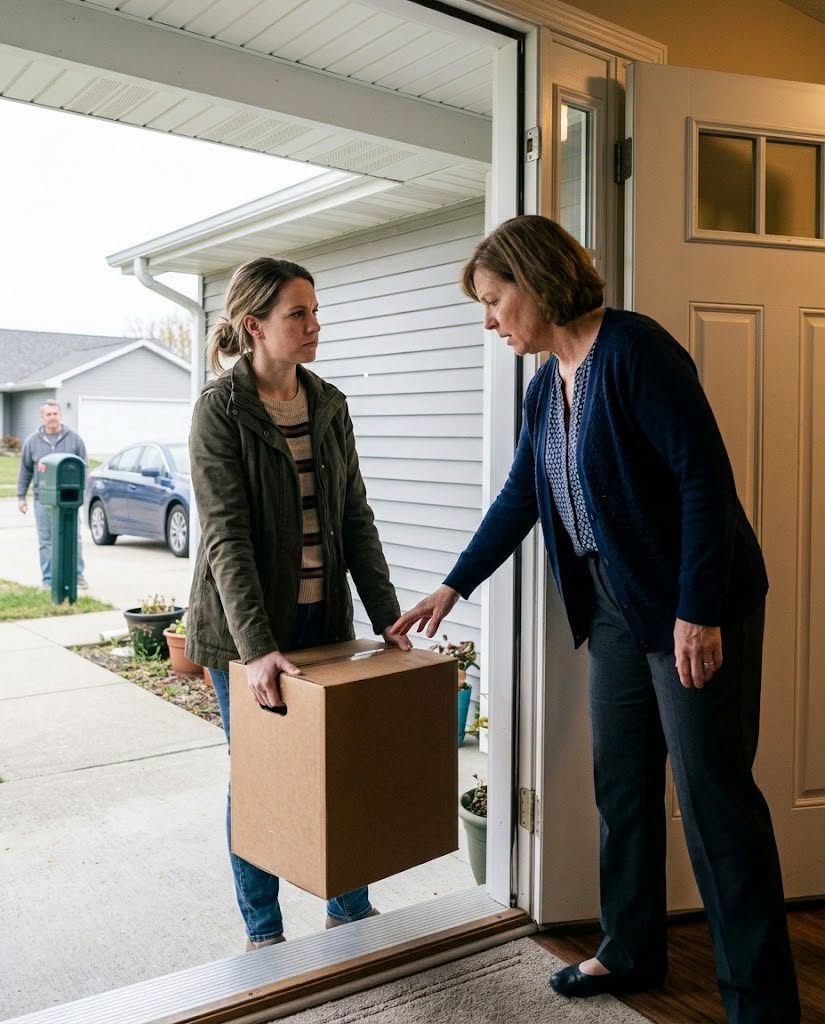
By the time Naomi finally placed down the burden she had carried for three years, her family was about to discover just how much of that household weight had actually been resting on her.
Her mother did not realize that when she reached into the box positioned by the front door.
She believed she was opening the last container of items Naomi had neglected to take.
She thought she still held the reins.
Instead, beneath a few mundane objects Naomi had intentionally left behind, there lay a tidy stack of documents.
Repair invoices.
Tax statements.
Payment confirmations.
A record of the furnace Naomi had replaced for $4,000.
Three years of expenses Naomi had managed while those around her slowly began viewing those payments as if they appeared on their own.
Her mother lifted the first page, frowning.
“What is this?”
Naomi stood several feet away, keys in one hand.
She had envisioned this moment differently during the sleepless nights following that dinner.
Initially, she had imagined herself explaining everything.
She would remind her mother about the winter when the furnace failed. She would remind her about the property tax issue. She would remind her about the calls she had made, the bills she had taken care of, the repairs she had organized, and the savings she had depleted because someone needed to keep the place running.
But she had already attempted that.
Her mother had listened to it all and still called her a parasite.
So Naomi did not deliver another speech.
“Copies,” she stated. “For your records.”
Her mother flipped through the pages more quickly.
The irritation on her face shifted to focus.
Then to concern.
Not remorse. Not yet.
Concern.
Because numbers are harder to disregard than memories.
A family can rewrite a favor.
They can claim it was less significant than you recall. They can assert you volunteered. They can argue you were living there too, so naturally, you should have contributed something.
But a receipt has no interest in safeguarding anyone’s pride.
Naomi had learned that during her meeting with Sophie.
The morning after she uncovered the “Room Setup” email thread, she walked into her old college friend’s office carrying a folder thick enough to strain her wrist.
Sophie dealt with property disputes, and Naomi had anticipated she would skim the initial pages and tell her there was nothing worth discussing.
Instead, Sophie continued reading.
There were repair invoices with Naomi’s payment details.
There were tax statements.
There were records indicating that Naomi’s contributions were not merely an occasional grocery run or a few dollars towards utilities.
It was a pattern.
A long one.
Sophie finally looked up.
“Naomi, they think they’re removing a daughter. They don’t realize they may be trying to remove someone who has established a genuine financial connection to this home.”
Naomi’s stomach knotted.
She could have perceived that as an invitation to argue.
Instead, she recognized it as confirmation of something she had feared to acknowledge.
She had tied too much of her life to a place where her role in the family could be revoked over dinner.
“I don’t want the house,” Naomi told her. “I want my life back.”
That response held significance.
Because Naomi’s next step was not about taking the house from her parents.
It was about finally disentangling herself from a system that functioned only as long as she remained available to rescue everyone within it.
For three years, Naomi had convinced herself she was helping temporarily.
One repair.
One tax issue.
One difficult month.
One more emergency.
Then another.
Each time, the choice seemed reasonable on its own.
Her parents needed assistance. Naomi had a steady job. Derek had his own life in Seattle. Naomi was already nearby.
So she took care of it.
Again.
And again.
And again.
The issue was that temporary help had quietly morphed into Naomi’s assigned role.
Nobody convened a meeting to announce it.
Nobody thanked her and said, From now on, you are responsible for keeping this family stable.
It unfolded in subtler ways.
A bill would become urgent, and her mother would call Naomi first.
Something in the house would break, and Naomi would be the one expected to resolve it.
A financial issue would arise, and the discussion would somehow steer toward what Naomi could do about it.
She became useful enough to rely on and familiar enough to stop being appreciated.
Then Derek needed to come home with his two children.
Suddenly, usefulness was no longer adequate.
Her mother wanted the rooms.
She wanted Derek to feel like “the head of a household again.”
And Naomi, the daughter who had spent three years helping maintain that household, became the easiest person to remove.
The cruelty was not merely that her mother requested her to leave.
Naomi was thirty-three. She had a job. Moving into her own apartment was not unreasonable.
What shattered something within her was the narrative her mother created to justify it.
“You’ve been living off my kindness for three years.”
That statement reversed three years of sacrifice.
Then came the word.
“Parasite.”
Naomi could still hear the way her mother pronounced it across the kitchen island.
Not accidentally.
Not amidst screaming.
Deliberately.
As if Naomi had contributed nothing.
As if the furnace had replaced itself.
As if the tax issue had resolved itself.
As if the money Naomi had spent had never belonged to her.
Naomi had stared at her mother for a few seconds and felt something unexpected.
Relief.
The guilt vanished.
She had spent years fearing that saying no would make her selfish.
Her mother had finally shown her that saying yes indefinitely would not make her valued.
Naomi departed without arguing.
She drove until the lights of Oak Ridge blurred behind her, pulled over, and accessed the shared household email account.
That was when she discovered the thread labeled “Room Setup.”
Derek’s message was succinct.
“Just make sure Naomi is out before the kids arrive. I don’t want her ruining the vibe.”
Her mother’s response stung more.
“Don’t worry, Derek. I’ve already started packing her things. Once she’s finally out, this house can feel like family again. It will finally be ours.”
Ours.
Naomi read the word twice.
For years, whenever the family required money, labor, time, organization, or patience, Naomi had been included in the term family.
When Derek needed her room, suddenly family meant everyone except her.
She closed the laptop.
No angry reply.
No warning.
That restraint altered everything that followed.
Naomi found a small apartment that week and signed a lease carrying only her name.
That detail provided her with more comfort than she anticipated.
Only her name.
No shared household responsibility.
No family arrangement concealed within it.
No emergency awaiting her signature.
She packed during lunch breaks and after work.
The essential documents went first.
Then sentimental items.
Then the clothes she actually wore.
She did not announce each trip.
She did not slam doors.
She allowed her mother to believe silence meant defeat.
By Friday morning, Naomi had moved nearly everything that mattered.
That was why the box near the front door was so crucial.
Her mother had packed it herself, believing she was aiding in pushing Naomi out.
Naomi had permitted a few items to remain there because she wanted the records beneath them to be uncovered in the exact location where her mother believed she had complete control.
Now her mother was holding those records.
Her eyes scanned from one page to another.
“You kept all this?”
“Yes.”
“Why?”
Naomi looked at the papers instead of her mother.
“Because they were my payments.”
Her mother’s mouth tightened.
“So this is what? A threat?”
“No.”
One word.
Nothing more.
Naomi had spent too many years transforming every boundary into an essay.
This time, she refused.
Her mother appeared almost frustrated by the absence of an argument.
“You consulted someone about this, didn’t you?”
Naomi did not deceive.
“I asked what my options were.”
That response resonated differently.
Her mother lowered the papers.
For the first time since announcing Derek’s return, she seemed to grasp that Naomi had ceased waiting for family permission to make decisions regarding her own life.
The front door opened again before either woman spoke further.
Derek entered, carrying the confidence of someone who believed the hard part had already been handled for him.
His children were coming into a house he had been told would be ready.
Naomi would be gone.
The rooms would be available.
His mother had managed the uncomfortable conversation.
Then he noticed Naomi.
Then he spotted the box.
Then he saw the papers in his mother’s hand.
“What’s happening?” he inquired.
His mother responded too quickly.
“Nothing.”
Naomi almost smiled at that.
Nothing.
Three years had reverted to nothing again.
Derek glanced between them.
“You’re leaving, right?”
Naomi picked up her keys.
“I am.”
He relaxed slightly.
That reaction communicated more to her than an apology ever could.
He still believed the argument revolved around whether Naomi would relinquish a bedroom.
It wasn’t.
Naomi was relinquishing the entire role.
Her mother began explaining before Naomi could reach the door.
“She’s trying to turn this into some huge financial issue.”
Naomi halted.
Derek looked at the papers.
“What financial issue?”
His mother hesitated.
It was a tiny pause, but Naomi noticed it.
Derek noticed too.
Naomi could have answered for her.
She could have enumerated every expense.
She could have told Derek precisely how insulting his email had been after everything she had done.
Instead, she allowed the papers to remain where they were.
Her mother had wanted Naomi out before Derek arrived because she wanted to control the narrative.
Now Naomi refused to assist her in telling it.
Derek took the top invoice.
His expression shifted when he saw the $4,000 furnace payment.
“You paid this?” he asked Naomi.
“Yes.”
He glanced at their mother.
“I thought you said she barely helped with anything.”
Their mother immediately altered the argument.
“She lived here too.”
Naomi had anticipated that.
Derek turned another page.
“And these?”
“Naomi chose to do that,” their mother stated.
There it was.
The sentence Sophie had cautioned Naomi about in a different form.
Help could always be recast as choice once the person receiving it no longer wished to feel indebted.
Naomi did not argue about whether she had chosen to help.
Of course, she had.
What she had never chosen was to be humiliated for it afterward.
“What do you want?” Derek asked.
Naomi met his gaze.
“My apartment.”
He blinked.
“That’s it?”
“That’s it.”
Her mother appeared skeptical.
Naomi understood why.
In their family, money had become intertwined with obligation for so long that nobody could imagine walking away without demanding something in return.
But Naomi meant it.
She did not want revenge.
She did not want Derek’s room.
She did not wish to punish his children for needing stability.
She wanted to awaken in a place where a broken furnace was not automatically her emergency.
She wanted her paycheck to belong to her before it belonged to anyone else.
She wanted one ordinary month where nobody called her selfish for not rescuing them.
So she departed.
She carried the last belongings that truly belonged to her to the car.
Her mother remained inside with the records.
Derek stayed beside her, reading.
Naomi drove to her apartment.
The place was small.
There were still boxes against the wall and almost nothing in the refrigerator.
But when Naomi unlocked the door, the quiet felt different from the silence she had experienced inside her parents’ house.
That silence had been defensive.
This one was hers.
She placed her keys on the counter.
No dramatic celebration ensued.
She unpacked a coffee mug.
She found a towel.
She plugged in her phone and went to sleep, utterly exhausted.
The following morning, the screen was filled with notifications.
Fifty-three missed calls.
Her mother.
Her father.
Derek.
Then her mother again.
And again.
The calls did not prove that they suddenly understood Naomi’s pain.
They were evidence that the old family system had recognized she was no longer standing within it.
There were inquiries about household matters Naomi had always managed.
Questions about records.
Questions about payments.
Questions Derek had never needed to ask because Naomi had quietly answered them for years before anyone realized there was a question.
Naomi sat on the edge of her bed and scrolled through the list.
Part of her wanted to call immediately.
That instinct was almost physical.
Fix it.
Explain it.
Help them.
Make everything calm again.
She had practiced that response for three years.
She picked up the phone.
Then she remembered the email.
“Once she’s finally out, this house can feel like family again.”
Naomi set the phone back down.
She did not block them.
She did not send a cruel message.
She simply stopped treating every ring like an emergency.
Later, she returned one call.
Derek answered.
His voice sounded different.
Less certain.
He had read enough by then to comprehend that Naomi had not been occupying a free bedroom while everyone else supported her.
She had been contributing money they had relied on and labor they had stopped noticing.
Derek attempted to explain the email.
He said he had been stressed.
He said Seattle had been challenging.
He said he had merely repeated what their mother had told him about Naomi’s situation.
Naomi listened.
She did not forgive him on cue.
But she recognized something significant.
Derek had arrived believing Naomi was the obstacle between him and a fresh start.
Now he was facing the reality that his fresh start had been prepared by pushing out the person who had spent years making the house easier for everyone else to utilize.
“I didn’t know,” he finally admitted.
Naomi believed part of that.
He had not known everything.
But he had known enough to write that he wanted her gone before the children arrived.
Not knowing the complete story did not erase that choice.
“You could have asked me,” Naomi replied.
Derek had no quick retort.
That mattered more than a dramatic apology.
Naomi ended the call without agreeing to return.
Her mother’s calls persisted.
Some were angry.
Some sounded wounded.
Some attempted to revert the situation back into a debate about gratitude.
Naomi did not debate.
The papers already existed.
Her decision already existed.
Her lease already existed.
There was nothing left to win at the kitchen island.
That was the part her mother seemed to struggle with the most.
For years, Naomi’s boundaries had been negotiable because Naomi herself kept reopening them.
A guilty phone call could change her mind.
A financial emergency could change her mind.
A reminder about family could change her mind.
This time, nothing altered her address.
Nothing changed whose name was on the lease.
Nothing changed the fact that the next household problem belonged first to the people residing in that household.
Naomi did not stop loving her family.
She ceased confusing love with permanent financial availability.
There was a distinction.
It took her longer to learn it than she wished to admit.
The most painful realization was understanding that the people around her might never agree with the boundary that saved her.
Her mother might always remember the situation as Naomi abandoning the family during a difficult time.
Derek might perpetually carry some version of the belief that his crisis should have surpassed Naomi’s exhaustion.
Her father might wish everyone could simply revert to the way things were.
But the way things were had relied on Naomi losing a little more of herself every time something went awry.
She could not return to that just because it had been convenient for everyone else.
Weeks later, the apartment still appeared unfinished.
There were boxes Naomi had not opened and inexpensive items she had yet to purchase.
Yet her bank account began to feel like hers again.
Her evenings began to feel like hers again.
Even her phone felt different.
A call could be a call.
It did not automatically have to become a task.
The copies of the receipts remained with her mother.
Naomi retained the originals with her own records.
She never needed to turn them into a weapon.
Their value was simpler than that.
They preserved the truth at the exact moment her family attempted to erase it.
Naomi had helped.
A lot.
She had sacrificed money she could have used to build her own future.
She had stayed because she believed staying mattered.
And when her mother decided Derek needed the house more, Naomi accepted the decision that she should leave.
She simply refused to accept the falsehood that she had been a parasite while she was there.
That was the real transformation.
Her mother had believed expelling Naomi would restore the family to some cleaner, happier version of itself.
Instead, Naomi’s absence compelled everyone left in the house to recognize the work she had been doing behind the scenes.
No revenge was necessary.
No grand confrontation was needed.
Naomi only had to stop carrying what they insisted had never been heavy.
The fifty-three missed calls indicated to her that they finally felt the weight.
Naomi glanced at the phone, turned it faced down on the counter, picked up her apartment keys, and walked out to commence a Saturday that belonged entirely to her.