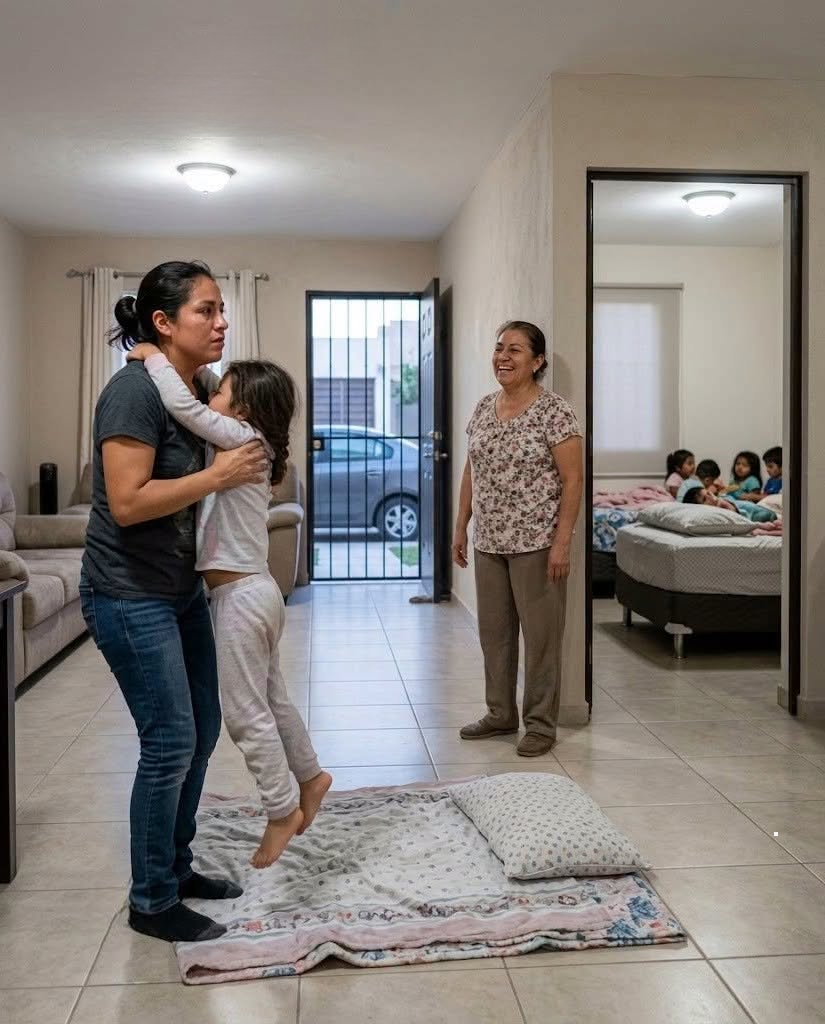
Seeing my mother’s name repeatedly appear on my phone, I realized that canceling the celebration had taken her by surprise in a way she hadn’t anticipated.
Three days prior, she had witnessed my six-year-old daughter attempting to sleep on a cold tile floor and acted as if nothing was out of the ordinary.
Now, it was her who couldn't calm down.
I looked at the screen for a few moments before placing the phone face down next to my coffee.
I wasn’t attempting to punish her.
That distinction was significant to me.
I wasn’t envisioning her feeling embarrassed or relishing the thought that she was panicking.
I was focused on Sofía.
About how she had gazed at me in the car before we even arrived at my mother’s home and quietly asked, “Mommy… does Grandma really like us?”
Children observe more than adults care to acknowledge.
They notice who receives the first greeting.
They notice which cousins are given the nice plates and which ones get the old plastic ones.
They notice made beds, fresh sheets, cookies on nightstands, and the lack of those comforts when it’s their turn to be cared for.
Most importantly, they notice when a parent continues to pretend not to see.
For years, I had been doing just that.
My name is Gabriela, and at thirty-three, I had structured my life around being reliable.
I worked in an emergency room, where twelve-hour shifts could extend unexpectedly and where someone always needed something urgently.
At home, Sofía and Mateo required breakfast, clean clothes, baths, school supplies, snacks, medicine when they fell ill, stories when they were frightened, and a mother who could somehow make everyday life feel stable even when she was fatigued.
Their father was no longer a part of my daily life as I had once anticipated.
Our marriage ended after I discovered he had cheated while Mateo was still in diapers.
I disliked discussing that time because people often sought a dramatic narrative when the reality was far less glamorous.
I was weary.
I was wounded.
I still had children to raise.
So I persevered.
My mother, Elena, had never forgiven me for the direction my life had taken.
She didn’t articulate that in one straightforward statement.
She conveyed it in fragments.
She mentioned the distance I lived from her.
She mentioned the divorce.
She mentioned how frequently Patricia visited.
She mentioned how Patricia drove her to appointments or brought groceries or sat with her after my father passed away.
All of those assertions were accurate.
Patricia lived twenty minutes away.
I lived almost four hours away.
Patricia could drop by during the week.
I worked long hospital shifts and had two young children to care for by myself.
None of that made Patricia wrong for being close to our mother.
What stung was witnessing my mother transform those circumstances into a ranking system for her grandchildren.
That November weekend made the hierarchy impossible to overlook.
I had completed a night shift, prepared a tray of lasagna, packed toys and blankets, loaded two eager children into the car before dawn, and driven nearly four hours because I still wanted my children to maintain a relationship with their grandmother.
I desired that enough that I had been rationalizing uncomfortable moments for years.
When no one came outside to welcome us, I reassured myself that everyone was preoccupied.
When Patricia’s family had already occupied the guest room, I told myself perhaps the sleeping arrangements had simply worked out that way.
When I noticed fresh sheets on the beds and cookies beside the water bottles, I felt a tightness inside me, but I still remained silent.
At dinner, the disparity became harder to justify.
Patricia’s children dined from the porcelain dishes that had belonged to my grandmother.
My children were given old plastic plates.
It seems trivial when you describe it as dishes.
That was how I had conditioned myself to think about these matters.
It’s merely a plate.
It’s just a room.
It’s only a greeting.
It’s just a cookie.
But children don’t perceive favoritism as a collection of inconsequential items.
They feel the message those items convey.
Later that evening, I overheard my mother tell an aunt that Patricia had been her lifeline since my father’s death.
I grasped why she felt grateful to my sister.
Patricia had been physically present in ways I could not be.
But I sat at the opposite end of the table cutting Sofía’s food while preventing Mateo’s cup from tipping over, and I noticed that my name never came up in the conversation.
I had become the daughter whose absence was remembered more vividly than anything she managed to give.
Still, I stayed.
At nine that evening, I finally inquired where we were supposed to sleep.
My mother went to a closet and retrieved two sleeping bags that had once belonged to my father.
She dropped them in the living room.
“The floor is clean,” she stated.
Sofía looked at them.
Then she glanced toward the guest room where her cousins had proper beds waiting for them.
“On the floor, Mommy?”
Before I could respond, Patricia appeared in the doorway.
“Well, you should have booked a hotel.”
Then she laughed.
There are moments when an argument would almost be simpler.
An argument gives everyone something loud to concentrate on.
It provides a way for people to claim both sides behaved poorly.
It gives them an excuse to forget what sparked the argument in the first place.
I didn’t offer anyone that escape.
I unrolled the sleeping bags.
I helped Mateo settle down.
I watched Sofía kneel on cold tile and shift her body around, trying to get comfortable.
Down the hall were made beds and cookies.
In front of me was my daughter on the floor.
That contrast did more than any speech could have accomplished.
Later, I found my mother in the kitchen.
I informed her that Sofía had asked whether her grandmother loved her.
My mother said I was exaggerating.
I pointed out the difference in how the children were being treated.
Her response was immediate.
Patricia came every week.
Patricia assisted with appointments.
Patricia brought groceries.
I had moved away.
I had gotten divorced.
“Decisions have consequences,” my mother told me.
I remember looking at her and reflecting on how peculiar that sentence sounded when the one feeling the consequence was six years old.
Sofía had not moved away from anyone.
She had not gotten divorced.
She had not chosen how far her mother’s job should be from her grandmother’s house.
She had simply arrived eager to visit family.
And somehow, she had ended the night questioning why her cousins were deemed worthy of a bed while she was not.
I could have debated for an hour.
Instead, I returned to my children.
Around eleven, Sofía came close to me and whispered, “Mommy, my back hurts.”
That statement concluded the internal debate I had been having.
I looked at Mateo sleeping beside her.
I looked at my daughter trying not to complain.
I looked at the old sleeping bags that had once belonged to my father.
And I finally realized that I had been asking the wrong question for too long.
The question was not whether I could compel my mother to treat my children equally.
I couldn’t control that.
The question was whether I would continue placing my children in situations where they had to endure the difference.
That part was mine.
“Pack your things, sweetheart,” I told Sofía. “We’re leaving.”
She didn’t protest.
She quietly placed her toys into her backpack while I gathered our blankets and lifted a half-asleep Mateo.
When my mother realized what I was doing, she followed us toward the entrance.
“Are you really leaving over this?” she asked.
I didn’t respond.
I had spent too many years justifying myself to people who interpreted every explanation as an invitation to debate my boundaries.
This time, I simply opened the door.
Sofía took my hand.
Then we walked outside together.
My mother had no idea that another decision had already been made before I crossed that threshold.
For three months, I had been helping organize a celebration for her that cost over 140,000 pesos.
Until that weekend, I had regarded the expense as something families do.
You contribute.
You show up.
You help make the day special.
You overlook the occasional resentment because family obligations are rarely perfectly equal.
But leaving my mother’s house altered the meaning of the money.
I kept envisioning Sofía on the tile.
I kept hearing Patricia laugh.
I kept recalling my mother telling me that choices had consequences.
By the time we returned home, the party no longer felt like generosity.
It felt like another iteration of the same pattern.
I was expected to absorb the inconvenience.
I was expected to quietly contribute.
I was expected to accept whatever role my mother assigned me in the family and still show up when something significant needed to be done.
Three days later, I stopped doing that.
I canceled the party.
There was no dramatic family announcement.
I didn’t send a lengthy message detailing the sleeping bags.
I didn’t demand an apology first.
I didn’t call Patricia to express my thoughts on her laughter.
I simply withdrew my time, my effort, and my money from a celebration I no longer felt responsible for supporting.
Then my mother began calling.
Again.
And again.
And again.
The urgency was unmistakable.
That was the part that lingered with me.
When Sofía mentioned her back hurting, my mother hadn’t suddenly become alarmed.
When her granddaughter questioned whether she was loved, my mother dismissed it as exaggeration.
When I gathered my children and departed, she regarded my decision as unreasonable.
But once the party was canceled, she immediately recognized that something significant had changed.
For the first time, I did not rush to alleviate her discomfort.
I went to work.
I returned home.
I prepared dinner for my children.
I assisted Sofía with the everyday things a six-year-old needs help with.
I checked on Mateo.
My phone kept lighting up.
Each time it did, I felt the old reflex urging me to respond quickly and smooth everything over.
That reflex had been ingrained in me over the years.
Be reasonable.
Don’t exacerbate the situation.
Remember what your mother has endured.
Remember Patricia does more because she lives closer.
Remember everyone is fatigued.
Remember family dynamics are complex.
All of those statements could be true without necessitating my daughter to sleep on the floor beneath a roof where another grandchild had a bed available.
That was the boundary I had finally learned to recognize.
Boundaries are sometimes portrayed as dramatic actions, but mine did not feel dramatic.
It felt practical.
My children had been shown where they stood.
I believed what I had witnessed.
That was sufficient.
I didn’t need my mother to agree with my interpretation before I protected them from experiencing it again.
I didn’t need Patricia to acknowledge that her joke had been unkind.
I didn’t need another relative to declare who had been right at dinner.
I needed to stop teaching Sofía that love meant enduring a place where she was clearly treated as less significant.
That was what mattered most to me.
Because six-year-olds eventually grow into older children who remember what their parents accepted.
I didn’t want Sofía to only recall the floor.
I wanted her to remember that when she told me her back hurt, I listened.
I wanted her to remember packing her backpack and walking out with me.
I wanted her to grasp that being related to someone did not necessitate accepting humiliation from them.
And I wanted Mateo, even though he was too young to comprehend everything that transpired that night, to grow up in a home where that principle applied to him as well.
My mother’s calls persisted because canceling the party had made my decision visible in a way leaving her house apparently had not.
Money had a way of prompting people to recognize boundaries they were willing to overlook when those boundaries involved feelings.
More than 140,000 pesos suddenly felt tangible.
The canceled plans were real.
My absence from the work behind the celebration was real.
And for once, I wasn’t volunteering to eliminate the consequences.
I reflected again on the sentence my mother had used in her kitchen.
Decisions have consequences.
She had meant my decisions.
My move.
My divorce.
My life.
But that principle did not belong solely to me.
Her decisions had consequences too.
Choosing to provide comfort for one set of grandchildren while telling another set to sleep on the floor had a consequence.
Laughing at my daughter’s discomfort had a consequence.
Treating my efforts as an obligation while viewing my children as optional had a consequence.
The consequence was not revenge.
It was that I ceased participating in the arrangement.
That difference brought me more peace than any argument could have.
I didn’t know whether my mother would ever perceive that weekend the way I did.
Perhaps she would continue to convince herself that Patricia had earned special treatment because she lived nearby.
Perhaps she would persist in believing I was too sensitive.
Perhaps she would focus entirely on the canceled party because that loss was easier to discuss than a little girl asking whether her grandmother loved her.
I could not control which version she chose.
I could control what transpired next in my own home.
That evening, after yet another missed call from my mother, Sofía sat beside me with the same backpack she had carried out of that house.
Nothing about it appeared dramatic now.
It was just a child’s backpack again, filled with toys and the small items she liked to carry around.
That mattered to me more than I anticipated.
Three nights earlier, I had watched her quietly pack those toys inside because she understood we were leaving a place where she no longer felt at ease.
Now she was home.
She had her own bed.
Mateo was nearby.
The ordinary rhythm of our life had returned.
My phone lit up once more with my mother’s name.
I glanced at it, then at my children.
For years, I had believed that being a good daughter meant answering every call, resolving every issue, contributing when asked, and swallowing whatever hurt seemed too complicated to address.
That weekend changed the definition for me.
I could love my mother and still refuse to let her choices teach my daughter that affection had to be earned through proximity, obedience, or usefulness.
I could appreciate what Patricia did for her and still reject the notion that my children deserved less because I lived farther away.
I could comprehend grief without allowing grief to become an excuse for favoritism.
And I could stop financing celebrations that required me to pretend none of that mattered.
So I left the phone where it was.
Then I turned back toward Sofía and Mateo, choosing the family in front of me instead of hastily rushing to soothe the feelings of someone who had made my daughter question whether she was loved.