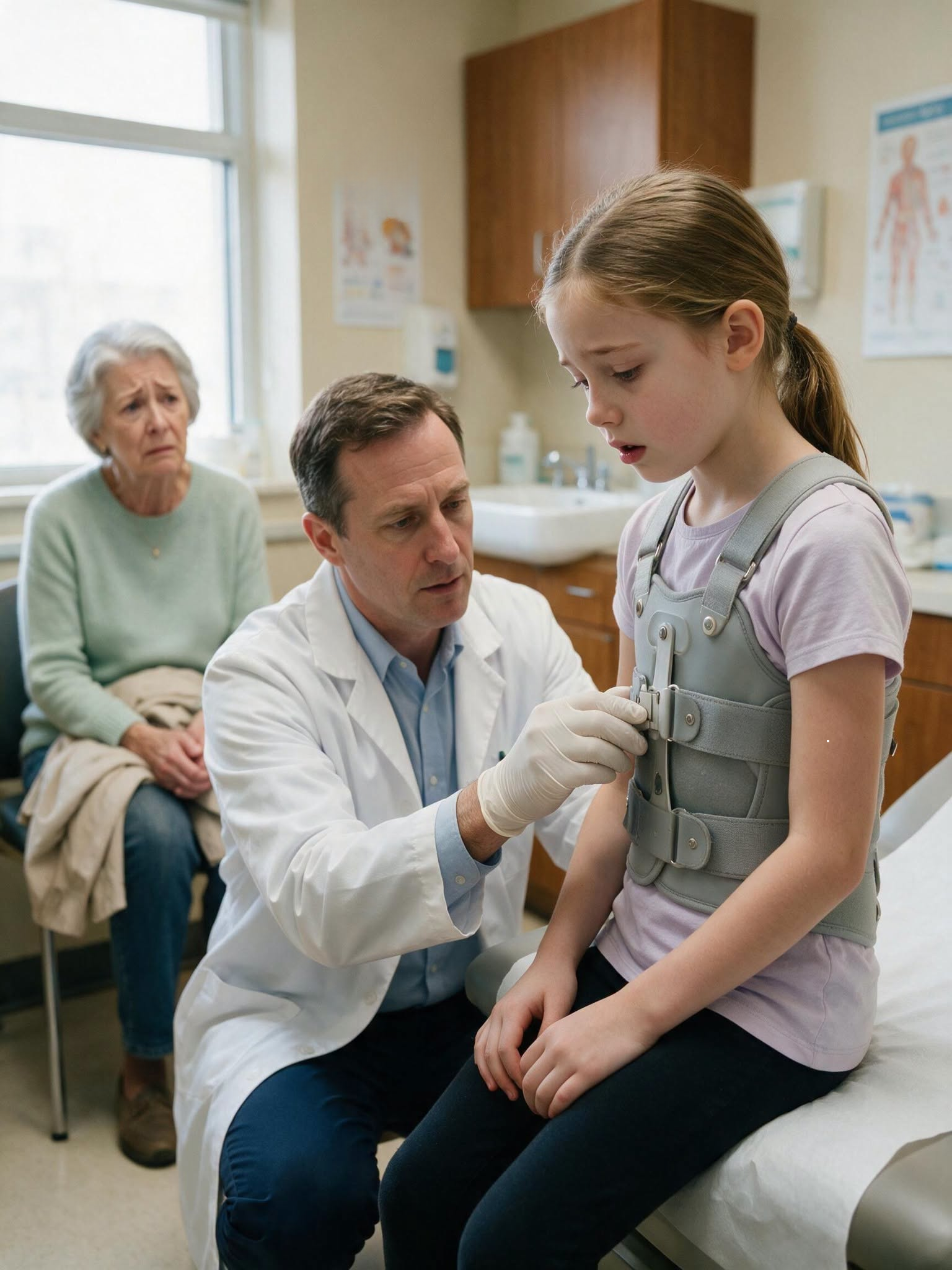
Part 1: The Padlock on My Brace
I was ten years old when my grandmother brought me into a rural orthopedic clinic with a small brass padlock attached to my back brace. A thin steel cable had been threaded through the release loops, preventing me from opening the straps without the key she kept in her purse.
The TLSO brace was intended to support my spine while doctors addressed a serious curve. I had been instructed to wear it for most of the day, but the written guidelines also mandated regular removal for bathing, skin checks, and emergencies.
Grandma started locking it after I walked down our gravel driveway to check the mailbox one evening. She informed my father that I had attempted to run into the road, then persuaded him that the clinic required the brace to be secured because I could not be trusted to follow directions.
My mother had passed away three years prior, and Dad worked an early shift at the lumber mill. Grandma arrived before dawn each morning, got me ready for school, and took me to all my medical appointments, which made her interpretation of my behavior easier for him to accept.
On the day of the appointment, my ribs ached where the edge of the brace had rubbed against my skin. Grandma refused to let me eat breakfast, claiming that children who complained before medical visits would only make themselves sick.
Dr. Alan Mercer, the orthopedic surgeon in charge of my treatment, noticed the padlock as soon as I took off my coat. He asked Grandma for the key, but she draped my coat over her lap and said she had accidentally left it at home.
“I can wait until the next appointment,” I replied.
Dr. Mercer looked at me instead of Grandma. He asked if I could breathe comfortably, if the brace had been removed that week, and if anyone had checked the skin beneath it.
Grandma answered every question before I could respond. She claimed I exaggerated discomfort, removed the brace whenever she looked away, and made up issues because I was embarrassed to wear it at school.
Dr. Mercer called a nurse into the room and requested that she bring a medical cable cutter. Grandma protested that cutting the lock would reward my disobedience, but he explained that no child should remain in a medical device that the clinic could not remove.
The cable snapped with one swift cut. When Dr. Mercer opened the straps, the padlock and two short pieces of steel fell onto the examination table.
I took the deepest breath I had inhaled in several days. Then I asked if I finally had permission to breathe.
The room fell silent. Dr. Mercer examined the dark pressure mark beneath my left arm and several irritated spots along my ribs, documenting their size and location in my medical record.
He asked Grandma to wait in the reception area while the nurse stayed with me. Grandma hesitated at first, claiming I would lie if she wasn't present, but the clinic manager escorted her outside after Dr. Mercer explained that he needed to speak with me privately.
Without Grandma behind me, answering still felt risky. Dr. Mercer inquired how often the brace was locked, and I told him I didn't know because she checked it every night before turning off my bedroom light.
“Could you remove it if you felt unwell or had trouble breathing?” he asked.
“No.”
“Did you ever have the key?”
I shook my head. The key remained on a ring inside the front pocket of Grandma’s purse, and sometimes she jingled it outside my bedroom before leaving.
Dr. Mercer informed me that the lock had never been prescribed by the clinic. He clarified that the brace was intended for treatment, not punishment, and that any discomfort should be reported so adjustments could be made.
A clinic social worker named Ms. Holloway joined us. She took photographs of the pressure marks for my medical record, documented my explanation, and informed me that the clinic was required to report concerns about a child being restrained inside a medical device.
The phrase “required to report” terrified me because Grandma had always said children who caused family trouble could be sent away. Ms. Holloway did not guarantee that nothing would change, but she assured me my father would be contacted and that no decision would be made without first ensuring I could return home safely.
Dad arrived from the mill nearly an hour later, with sawdust caught in the cuffs of his work shirt. Grandma met him in the waiting area and immediately claimed I had upset myself over a safety measure she had been forced to implement.
When Dad entered the examination room, his gaze moved from my exposed pressure mark to the cut cable sealed inside an evidence bag. He appeared confused rather than angry, which made me realize he truly had no idea what Grandma attached to the brace.
“She told me the clinic required something to keep it closed,” Dad said. “I thought the lock was part of the treatment.”
Dr. Mercer placed the manufacturer's instructions in front of him. He pointed out the section requiring daily skin inspections and demonstrated how every strap was designed to open quickly without a tool.
Grandma stood near the doorway and insisted Dad had misunderstood her. She maintained that she had only told him the clinic wanted the brace kept on, not that the clinic had provided the lock.
Dad stared at the pressure mark beneath my arm. Then he confessed he had never read the instructions because Grandma attended the fitting appointment and said she understood everything.
Dr. Mercer picked up the sealed bag containing the padlock. His voice remained steady, but he did not look away from my father.
“Who told you that preventing your daughter from removing this brace was medically necessary?”
Dad slowly turned to Grandma. “Mom, you told me the lock came from this clinic.”
Part 2: What the Sound of Keys Meant
Grandma did not deny buying the padlock. She claimed she had misunderstood the clinic’s instructions and believed securing the brace was the only way to prevent me from removing it.
Ms. Holloway asked if Grandma had consulted Dr. Mercer before adding the cable. Grandma replied that she had not needed permission to keep her granddaughter safe.
“She walked toward the road,” Grandma explained. “Her father was at work, and someone had to be responsible.”
I clarified that I had walked to the mailbox once because the red flag was still raised after supper. The mailbox was located at the end of our gravel driveway, several yards from the road, and I had stopped when Grandma called my name.
Grandma told Dad I had been wandering toward traffic. From that point on, every request for independence became evidence that I could not be trusted.
A county child-protection investigator arrived at the clinic before we were allowed to leave. Ms. Reese interviewed Dad, Grandma, and me separately, then reviewed the photographs and Dr. Mercer’s medical notes.
I informed her that Grandma only unlocked the brace when she deemed it time for me to bathe. On several occasions, I felt unwell or could not get comfortable, but the key remained in Grandma’s purse after she went home.
Dad had assumed Grandma removed the brace before bed. He looked at the floor when Ms. Reese explained that I had sometimes slept in a locked device without any adult in the house holding the key.
“Why didn’t you tell me?” he asked.
I glanced at the sawdust on his sleeve and said Grandma warned that every complaint could make him miss work. The mill had already disciplined him for leaving early after one of my school appointments, so I believed silence was how I protected his job.
Dad started to say I should have trusted him, but Ms. Reese gently interrupted. She reminded him that adults were responsible for creating conditions in which a child could speak safely.
Earlier that week, the school nurse had asked if the brace hurt. Grandma stood behind me with one hand on my shoulder, and I responded that everything felt fine.
Ms. Reese noted the nurse’s name for follow-up. She stated the school would need to update its records and interview me again without Grandma present.
Before releasing me, Dr. Mercer adjusted the brace and ensured I could open every strap myself. He instructed Dad to inspect my skin daily and to call the clinic if any area became painful or difficult to breathe against.
The clinic filed a formal report, but Ms. Reese did not remove me from Dad. She established a written safety plan stating that Grandma could not supervise me alone, attend medical appointments, or transport me while the investigation was ongoing.
Dad signed the plan. He also completed new clinic paperwork revoking Grandma’s authority to consent to treatment or receive medical information.
Grandma referred to the process as an overreaction. She reminded Dad that his shift began before dawn and asked who would prepare breakfast, take me to school, or stay home when I was sick.
Dad did not have an answer. Still, he signed the final page and told her he would find another arrangement.
On the drive home, my stomach cramped loudly enough for him to hear. Dad stopped at a gas station and bought me a warm biscuit and orange juice, then sat beside me in the truck without eating.
The clinic had placed the cut cable and padlock inside a paper evidence bag. When Dad reached toward it, I placed my hand over the top and asked if I could keep it after the investigation was concluded.
He agreed. Then he inquired how often Grandma had locked the brace, and I could only respond that it occurred too many times to count.
At home, Ms. Reese met us to ensure Grandma surrendered her house key and did not remain alone with me. Grandma arrived several minutes later, carrying my coat and speaking as if the appointment had ended normally.
Dad asked for the key to our front door. Grandma reminded him of every early morning, school holiday, and illness she had managed since my mother died.
“You think the mill will change production because you suddenly want to become a full-time father?” she asked.
Dad extended his hand. After several minutes, Grandma removed the silver house key from her ring and dropped it into his palm.
The sound of the keys clinking against one another made my shoulders rise. Dad noticed my reaction and asked Grandma for the smaller brass key as well.
She pretended not to understand until Ms. Reese reminded her that the padlock was part of an active child-protection report. Grandma rummaged through the front pocket of her purse and placed the little key on the kitchen table.
She insisted the lock had never been meant to harm me. According to her, the pressure marks were a result of my deliberately rubbing against the brace to make her seem cruel.
Dad asked her to leave. Grandma picked up her purse and told him he would call before his next shift because inconvenience always triumphed over good intentions.
Before departing, she looked directly at me. “I hope you understand what you’ve initiated.”
“I do,” I replied.
After the door closed, Dad locked it and placed her house key beside the padlock key. I opened the paper bag from the clinic and set the two cut pieces of cable next to them.
For the first time, Dad saw the three items together. The house key had allowed Grandma into our home, but the smaller key had taught me that even inside it, I was never free unless she chose to release me.
Part 3: The Price of Keeping Her Away
The first week without Grandma was harder than Dad admitted. He had spent years leaving for the mill before daylight and did not know how long it took a ten-year-old to eat breakfast, manage a brace, and prepare for school.
He woke me too early the first morning and burned the toast while making my lunch. On the second, I spilled milk across the table, and on the third, he sent me to school wearing mismatched socks.
Nothing catastrophic happened. That surprised both of us because Grandma had always described ordinary mistakes as evidence that our lives would collapse without her.
Dad called the mill and requested a later start while the child-protection investigation continued. His supervisor granted him several days but removed his early-shift premium and the Saturday overtime he had expected to use for the electric bill.
I understood what the lost money meant. Dad stood at the kitchen counter after I went to bed, sorting three unopened bills into different piles beside his calculator.
“You can call Grandma,” I suggested one evening.
Dad glanced toward the telephone and then at the safety plan attached to the refrigerator. He told me losing money was his issue to resolve, while returning me to someone who had restrained me would create a problem I could not tackle alone.
Ms. Reese visited twice that week. She inspected the house, confirmed Grandma no longer had authorized access, and required Dad to begin a parenting-support program focused on medical care and recognizing signs of coercion.
She did not exonerate him simply because Grandma had lied. Dad was accountable for failing to read the brace instructions, inspect my skin, or ask why I became tense whenever Grandma answered questions on my behalf.
He accepted that without contesting it. Hearing him admit he had failed to notice was uncomfortable, but it felt safer than hearing another adult explain why nothing had really been his responsibility.
At school, the nurse met with me privately. I revealed that I had denied feeling pain because Grandma was standing behind me during the previous examination.
The nurse documented the disclosure and filed her own mandated report. She also altered the procedure so students with medical devices would be asked at least some questions without a caregiver in the room.
Dad removed Grandma from my school pickup list and provided the office with a copy of the safety plan. Only Dad and Mrs. Daley, the mother of one of my classmates, were authorized to take me home.
Mrs. Daley could help on some afternoons but not before school. When the mill informed Dad that his temporary schedule would end the following Monday, he sat at the kitchen table holding the notice long after dinner had gone cold.
Reporting at his regular time meant leaving the house while I was asleep. Arriving late could cost him his position on the crew and further reduce our income.
Dad lifted the telephone receiver and began dialing Grandma’s number. I stood in the hallway, listening as each number returned us to the arrangement Ms. Reese had warned him not to repeat.
Before completing the call, he placed the receiver back on its cradle. He contacted Ms. Reese instead and admitted he did not have a safe childcare plan for Monday morning.
She assisted him in applying for an emergency subsidy through a before-school program operating at my elementary school. The program opened early enough for Dad to drop me off before heading to the mill, although the added distance still made him several minutes late for his shift.
Dad’s supervisor moved him to a less favorable crew with fewer premium hours. We postponed two utility payments, bought less meat, and stopped using the truck except for work, school, and appointments.
I began preparing my clothes and lunch the night before. Dad reminded me that helping was acceptable, but keeping the household running was not supposed to become my responsibility simply because Grandma was no longer around.
The before-school program was noisy and smelled like cereal, floor wax, and wet coats. I disliked being there initially, but nobody inspected my posture, tightened my brace without asking, or followed me when I walked to the bathroom.
After two weeks, our routine became predictable. Dad dropped me off, signed the attendance sheet, and waited until a staff member saw me enter before leaving for work.
Grandma called the house in the evenings. She inquired if Dad was tired, whether my grades had slipped, and how long he believed strangers would care for me better than family.
Dad never put her on speakerphone. When she asked to speak to me, he reiterated that contact would occur only after Ms. Reese approved it and I consented.
One Thursday afternoon, my teacher received a message instructing me to report to the principal’s office. I assumed Dad’s schedule had changed until I saw Ms. Holloway, the school secretary, waiting outside the classroom.
She walked beside me without explaining why. When we arrived at the office, I heard Grandma’s voice through the closed door.
She told the principal that Dad had called that morning and authorized her to collect me. She claimed the child-protection investigation was a misunderstanding that had already been resolved.
My name remained crossed out beside hers on the old pickup form, and the new authorization listed only Dad and Mrs. Daley. The principal refused to release me and contacted both Dad and Ms. Reese.
Grandma raised her voice, insisting the school was preventing a grandmother from caring for her own family. Then she asserted that Dad would lose his job if no one allowed her to take responsibility again.
I stood in the hallway holding the bottom strap of my brace. Through the office window, Grandma saw me and lifted her purse from the chair.
The keys inside clinked against one another with the same sharp jingle I used to hear outside my bedroom. She smiled and gestured for me to come toward the door as if the school had already agreed to let me leave.
Part 4: The Story Grandma Could No Longer Control
I did not move toward the office door. Ms. Holloway noticed where I was looking and guided me into the nurse’s room before Grandma could enter the hallway.
The principal informed Grandma that she was not authorized to remove me from school. When she refused to leave, he contacted the district safety officer and issued her a written warning that returning without approval could be treated as trespassing.
Dad arrived from the mill with Ms. Reese a few minutes behind him. Grandma immediately claimed he had called and asked her to collect me because the before-school arrangement was harming his job.
Dad showed them his telephone records and denied making the call. He admitted he had nearly contacted her two weeks earlier, but he had never restored her authority or altered the safety plan.
Grandma insisted the distinction did not matter because she knew what her son needed. She portrayed herself as the only person willing to sacrifice for our family, while the school and child-protection agency were creating problems they would not help us pay for.
Ms. Reese documented the attempted pickup as a violation of the safety plan. The school retained its updated list and instructed staff to notify Dad, Ms. Reese, and the police if Grandma returned.
I stayed in the nurse’s office until Dad came for me. He apologized for taking so long, but I was more interested in whether he had believed Grandma when she said he would lose his job.
“I believe she knows what scares me,” he replied. “That doesn’t mean she gets to use it to reach you.”
The investigation continued for several more weeks. Ms. Reese reviewed the clinic records, the school nurse’s report, and the instructions provided when I first received the brace.
She concluded that Grandma had intentionally altered a medical device and prevented me from removing it despite visible skin irritation. She also found that Dad had failed to supervise my care adequately, although he had acted to protect me once the truth became evident.
I remained at home because Dad adhered to the safety plan, attended the parenting program, and secured reliable childcare. The agency required him to continue medical follow-up and prohibited Grandma from having unsupervised contact.
Grandma was offered the opportunity to participate in counseling and a caregiving assessment. She agreed only after learning that refusing could prevent future contact with me.
Our first supervised family meeting occurred in a small room at the county services office. Ms. Reese sat nearby while Grandma talked about the weather, Dad’s work, and my grades as if the padlock had never existed.
When she reached across the table to smooth my hair, I moved my chair back. She withdrew her hand, and Dad told her she needed to ask before touching me.
Grandma appeared offended. She said families should not require permission for ordinary affection, but Ms. Reese reminded her that rebuilding trust meant allowing me to control what happened to my body.
I asked Grandma why she had locked the brace at night. She reiterated that I wandered and could not be trusted, so I corrected her in front of everyone.
“I walked to the mailbox once,” I stated. “I did not run into the road.”
Dad confirmed my account. For the first time, Grandma could not tell him one version and tell a doctor or school employee another.
She still did not apologize. She claimed people were judging decisions they had never been forced to make and insisted that nothing serious had occurred because the pressure marks were already fading.
The supervised meeting ended early when she refused to discuss the fear caused by the lock. I chose not to attend another visit that month, and neither Dad nor Ms. Reese pressured me to change my decision.
At home, life remained imperfect. Dad forgot one clinic appointment, bought the wrong undershirts for my brace, and once sent me to school without lunch.
Those mistakes did not restore Grandma’s authority. He rescheduled the appointment, exchanged the undershirts, and brought my lunch to the school office during his break.
Several weeks later, Dad accompanied me to the orthopedic clinic. Dr. Mercer examined the mark beneath my arm and confirmed that the skin was healing without permanent injury.
He asked if the brace still caused pain. My first instinct was to say no, but I pointed to a section near my ribs that pinched whenever I sat for a long time.
Dr. Mercer adjusted the padding and asked me to try again. When I reported that it still hurt, he made a second adjustment instead of accusing me of complaining.
Then he asked me to demonstrate how I removed the brace. Dad remained against the wall while I reached for the straps myself.
I opened the first release, then the second and third. The brace lifted away from my body without a cable striking the table or a key jingling behind me.
Dr. Mercer asked who controlled the lock now. I glanced at the open brace resting in my own hands.
“There isn’t a lock,” I stated. “I can take it off when I need help.”
Part 5: The Key That Opened My Own Home
The pressure mark beneath my arm disappeared over the next two months, but the fear related to the brace lingered longer. I still checked the straps several times before bed and woke whenever I imagined hearing keys outside my room.
Dad began knocking before entering. He also asked before assisting with the brace, even when we were running late and allowing me to adjust it myself required extra time.
At every clinic visit, Dr. Mercer asked me directly where the brace hurt. I gradually learned that reporting discomfort did not signify disobedience; it provided the doctor with the information he needed to make the treatment safer.
The school nurse checked my skin once a week with my consent. She always spoke with me alone first, then invited Dad into the room if there was something he needed to know.
I continued carrying emergency crackers in my backpack. Even when breakfast was waiting on the table, I felt calmer knowing food was available if an adult determined I had not behaved well enough to eat.
Dad never took the crackers away. When they became stale, he quietly replaced them and reminded me that meals were not rewards I had to earn.
His work situation remained challenging. The later crew offered him fewer premium hours, and we postponed replacing the truck’s worn tires until the mill provided him with additional weekend shifts.
The before-school subsidy covered most of my care, while Mrs. Daley remained an approved emergency contact. Dad disliked asking for help outside the family, but he learned that safe support mattered more than shared blood.
Ms. Reese continued visiting our home until she believed the changes would endure after the investigation concluded. Dad completed the parenting program, attended every medical appointment, and stopped treating Grandma’s explanations as more reliable than my responses.
Sometimes he still asked whether I planned to wander when I went outside. The first time, I returned to the house because the word made me feel as though Grandma’s version of me remained stronger than mine.
The next time, I corrected him. I reminded him that I had walked to the mailbox once and had never tried to run away.
“You’re right,” Dad acknowledged. “Where are you going?”
“To the porch.”
“All right. Let me know if you need anything.”
That exchange seemed minor, but it shifted the focus from whether I could be trusted to where I had chosen to go. Dad did not follow me or stand at the window until I returned.
Grandma attended several more supervised counseling sessions. She eventually admitted the clinic had never prescribed the lock, but she continued insisting fear had forced her to make a difficult choice.
I did not forgive her simply because adults wanted the family conflict resolved. Ms. Reese allowed me to decide whether I attended each visit, and for several months I chose not to see Grandma at all.
Later, I agreed to a brief supervised meeting in a public room. Grandma asked before sitting beside me and kept her purse on the opposite side of the table, where I could not hear the keys move.
She apologized for frightening me but still struggled to define what she had done as abuse. Our relationship remained limited because an apology without full accountability could not restore the trust the padlock had taken.
Child protection closed the case after nearly seven months. The written closure confirmed that I could stay safely with Dad, while any future contact with Grandma had to respect the boundaries set during the investigation.
I wore the brace for another year. When my treatment finally ended, Dad placed it in the back of a closet rather than discarding it without consulting me.
The cut cable and padlock remained sealed in the clinic’s case file until they were no longer needed. I never requested them back because I eventually understood that keeping proof did not necessitate holding onto the object beside me forever.
A few months after the case closed, our front-door lock began sticking whenever the weather became humid. Dad bought a new deadbolt and asked me to sit on the porch while he installed it.
I held the screws in my hand and watched him remove the old lock. The replacement came with three plain brass keys.
Dad placed one on his key ring and another in the kitchen drawer. Then he held the third one toward me.
“What’s that for?” I inquired.
“You live here,” he replied.
I did not take it right away. The key rested across the same fingers that had once accepted Grandma’s house key and the smaller key she used to control my brace.
Dad did not tell me I was too young or caution me not to lose it. He waited until I chose to reach for it.
I placed the key inside the zippered pocket of my backpack next to the crackers I still carried. Nothing was attached to it, and it did not control anything worn against my body.
Grandma’s padlock key had meant I could leave only when she allowed it. The new key signified I could enter my own home without needing anyone to release me first.
Years later, that is the detail I remember most distinctly. My father did not fix everything in one dramatic day, but he accepted inconvenience, lost income, and changed his life until safety no longer depended on my silence.
The first key taught me that adults could disguise control as protection. The second taught me that genuine protection gives a child a way to open the door.