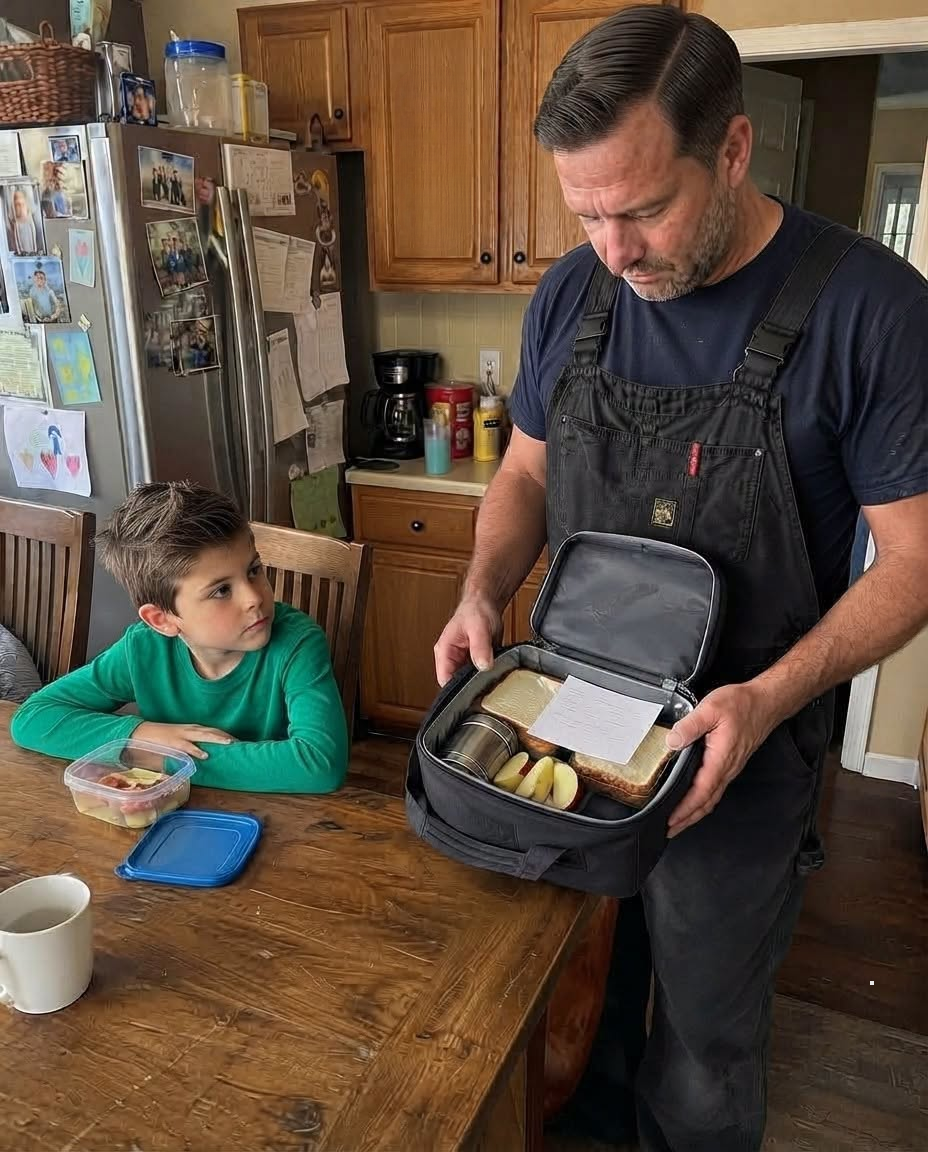
For twelve years, I prepared the same lunch for my husband each morning.
Two sandwiches.
Apple slices.
Black coffee.
And a handwritten note tucked under his napkin.
Then one Tuesday, our ten-year-old son strolled into the kitchen and casually remarked,
“Mom, maybe you shouldn’t make Dad lunch anymore.”
I chuckled.
“Why?”
Jamie appeared puzzled.
“Because he leaves it next to the trash can every morning.”
My hands froze.
Then he added,
“And yesterday he changed into his wedding suit and got into a woman’s car.”
For twelve years, I believed I knew precisely where my husband went each morning.
The following day, I decided to follow him.
When I uncovered the truth, I realized Edward had concealed an entire life from me for nine years.
I have always thought that marriages are maintained by small routines.
Not anniversaries.
Not lavish vacations.
Not grand proclamations of love.
The little things.
The habits that nobody else sees.
For Edward and me, one of those routines was lunch.
Each morning, I packed him two sandwiches because he was a large man doing physical construction work.
I added sliced apples because early in our marriage, Edward had mentioned that his mother used to include an apple in his lunch during his childhood.
He said it made packed lunches feel like home.
I remembered.
So there were always apples.
Next came a thermos filled with black coffee.
Edward had been drinking coffee that way since he was nineteen when he first started in construction.
Lastly, there was the note.
That tradition began during our first week of marriage.
I recall glancing at his plain brown lunch bag one morning and thinking it looked too practical.
Food.
Napkin.
Coffee.
Nothing about it conveyed that I thought of him while he was still asleep.
So I grabbed an index card and wrote something small.
I don’t remember the exact words.
Probably something simple like:
Have a good day. Love you.
I folded it and tucked it underneath the napkin.
That evening, Edward mentioned it.
“That note made me smile.”
Then he confessed he had read it twice.
So I wrote another one the next morning.
And another.
And somehow, that turned into twelve years.
I never kept copies.
Sometimes I wish I had.
But each morning, I would sit at the kitchen counter and decide what small piece of our life belonged on that card.
When our son Jamie was little, he would sit on the counter and watch me write.
Once he learned to spell, he started adding his own messages.
BE SAFE DAD.
BRING PIZZA HOME.
I LOVE YOU DAD. FROM JAMIE.
Every evening, Edward returned home with an empty lunchbox.
He would place it on the kitchen counter, kiss me, inquire about Jamie’s day, shower, and then sit down for dinner.
I assumed the empty lunchbox meant exactly what any wife would assume.
My husband ate the lunch I prepared.
Then, one Tuesday morning, everything changed.
Jamie was ten.
He wandered into the kitchen still in his pajamas while I was preparing Edward’s sandwiches.
He observed me quietly for a moment.
Then said,
“Mom, maybe don’t make Dad lunch today.”
I laughed.
“Why?”
He frowned, as if my question was obvious.
“Because he throws it away by the corner anyway.”
I set down the knife.
“What?”
“Our school bus stopped there yesterday.”
Jamie leaned against the counter.
“I saw Dad leave your food next to the trash.”
My stomach knotted.
Then he added nonchalantly,
“And he changed into his wedding suit and got into a lady’s car.”
I stared at him.
“Jamie, go get dressed for school.”
He shrugged.
“Okay.”
And walked away.
I stood alone in the kitchen.
The sandwich was half complete.
The thermos sat beside me.
And suddenly, twelve years of ordinary mornings no longer made sense.
Still, I finished packing the lunch.
Two sandwiches.
Apple slices.
Coffee.
And the note.
I wrote it just as I always did.
Folded it.
Placed it beneath the napkin.
Then I set the bag on the counter.
Edward came downstairs at 6:50.
He kissed my forehead.
Picked up the lunch.
“I’ll be home around six.”
“Okay.”
Then he departed.
I lingered at the kitchen table with my coffee long after his truck vanished.
Twelve years.
Twelve years of empty lunchboxes.
I had always viewed them as evidence that the food had been consumed.
Now I had no idea what they signified.
And then there was the suit.
Edward owned precisely one suit.
Dark navy.
The same suit he had worn when we married twelve years prior.
Construction workers don’t have many reasons to own formal attire, so he wore it to funerals, weddings, and once to Jamie’s school awards ceremony.
That was it.
Why would he secretly change into it on a regular weekday?
And who was the woman?
The obvious answer frightened me.
But something about the situation was so peculiar that I needed to see it myself before confronting him.
So the next morning, I woke up before Edward.
I dressed quietly.
Took my car keys.
And waited.
When the kitchen lights turned on, I moved my car down the street so he wouldn’t spot it.
At 6:51, Edward pulled out of the driveway.
I followed.
For the first twenty minutes, he drove toward the construction site where I believed he worked.
Then he turned onto a residential street a few blocks away.
He pulled over.
I parked roughly a hundred yards behind him.
And watched.
Edward exited carrying his lunch bag.
He walked toward the corner.
There was a trash can there.
My chest tightened.
Then he placed the lunch bag carefully beside it.
Not inside the trash.
Beside it.
He opened the bag.
Pulled out my note.
Unfolded it.
And read it.
Then he paused.
Went back to the beginning.
And read it again.
Something inside me relaxed.
Whatever else was occurring, he wasn’t discarding the notes.
He folded the card and slipped it into his pocket.
Then he returned to his truck.
Opened the back.
And pulled out a duffel bag.
I watched him remove his construction overalls.
Underneath, he changed into the navy suit.
Our wedding suit.
He adjusted the jacket.
Fixed his hair using the side mirror.
And when he finally stood beside the truck fully dressed, I had the strangest sensation.
He resembled the man I had married twelve years ago.
Twenty minutes later, a silver car arrived.
A woman stepped out.
She appeared around Edward’s age.
Early forties.
Dark hair.
Professional attire.
Blazer and trousers.
She walked directly toward him.
And hugged him.
He embraced her back.
Then Edward climbed into her passenger seat.
They drove away.
I followed.
They crossed town and entered a more modern business district I rarely visited.
Finally, they halted in front of a sleek three-story glass-and-steel building.
The woman exited.
Edward followed.
They began conversing near the entrance.
I parked and exited my car.
As I approached, I overheard her say,
“Twelve years, Edward. Your wife still thinks you’re a construction worker?”
I stopped.
Edward replied,
“You’re right. I can’t keep hiding who I really am.”
My chest tightened.
Then he added,
“I’ll tell her tonight.”
I stepped forward.
“What exactly are you going to tell me?”
Edward turned around.
The look on his face changed immediately.
“Rachel.”
The woman stepped back, clearly realizing this conversation wasn’t hers.
I looked at Edward.
“Jamie saw you Tuesday.”
He froze.
“He saw you leave the lunch by the trash.”
“Rachel—”
“And he saw the suit.”
My voice trembled.
“He saw you getting into this woman’s car.”
Edward stepped toward me.
“I’m not having an affair.”
“Then explain what this is.”
I pointed at him.
“The clothes. The lunches. Her. This building.”
He glanced at the woman.
Then at me.
“Come inside.”
I followed them through the doors.
The lobby struck me almost immediately.
Architectural models covered one wall.
Beautiful miniature buildings.
Bridges.
Hospitals.
Libraries.
Large professional photographs adorned another wall.
A polished sign behind reception read:
MERIDIAN ARCHITECTURE GROUP.
Then I noticed a display case.
Awards.
Certificates.
Photographs from completed projects.
And in several of those photographs stood a man who looked just like my husband.
Because it was my husband.
I slowly turned around.
Edward stood behind me.
He looked at those photographs differently than I had ever seen him look at anything.
Like someone standing inside a place he belonged.
“This is my firm,” he said.
I stared at him.
“What?”
“Meridian.”
He swallowed.
“I’ve owned it for nine years.”
“You’re an architect?”
“Yes.”
I actually sat down.
There was a chair near reception, and my legs suddenly decided they were finished supporting me.
“Nine years?”
“Yes.”
“Jamie is ten.”
“I know.”
I gaped at him.
“So for almost his entire life, you’ve been…”
I couldn’t even finish.
“Why?”
Edward sat across from me.
“Why didn’t you tell me?”
He looked down.
“I was afraid.”
“Of what?”
“When you met me, I truly was a construction worker.”
He rubbed his hands together.
“That’s who you fell in love with. The guy wearing boots and dusty work clothes. The man who came home exhausted and didn’t know which fork to use at your mother’s dinner table.”
“Edward…”
“I thought if I became something else, maybe I wouldn’t be the person you loved anymore.”
I stared at him.
“That makes no sense.”
“I know.”
He nodded.
“It sounds cowardly because it was.”
“You didn’t trust me.”
He fell silent.
Finally, he said,
“No. I didn’t.”
The woman from the car appeared again.
“I’m going upstairs,” she said. “Take your time.”
Then she left.
I looked after her.
“Who is she?”
“Margaret Chen. My business partner.”
“You started this company together?”
“Yes.”
“And she knows about me?”
“Yes.”
“How long has she been urging you to tell me?”
Edward almost looked embarrassed.
“Since the first week.”
I laughed once, without humor.
“So she knew this would become a disaster nine years ago.”
“Yes.”
“She was right.”
“Completely.”
I glanced around at the architectural models.
“Have I ever been inside one of your buildings?”
Edward hesitated.
“Three.”
My head snapped toward him.
“Which ones?”
“The children’s hospital on Grant Street.”
I stared.
“The library extension on the east side.”
Then he paused.
“And the pedestrian bridge.”
My stomach dropped.
“I’ve walked across that bridge.”
“I know.”
“I sent you a photograph when it opened.”
“I remember.”
“I told you it was beautiful.”
“I know.”
I couldn’t believe it.
I had sent my husband a photograph of something he had designed and told him how beautiful it was.
And he had simply thanked me.
“Does Jamie know?”
“No.”
“Does anyone know?”
“My professional name is E. Cole. The business license is held through a company. The firm uses this address, not our home address.”
He looked ashamed.
“I created an entire second life and kept telling myself I would explain next year.”
“Nine next years.”
“Yes.”
I looked at his suit.
“And the overalls?”
“I put them on every morning.”
“You actually dress like a construction worker just to leave the house?”
“Yes.”
“And then you change here?”
“At the corner.”
“And you change back before coming home?”
“Yes.”
“For nine years?”
“Yes.”
I covered my face.
Then another question struck me.
“The lunches.”
Edward was quiet.
“What happened to the food?”
“There’s a man named Robert.”
I lowered my hands.
“What?”
“He works the early shift at a diner on Farber Street. He’s sixty-two. Money has been tough for him for years.”
Edward gave me a cautious look.
“He eats the lunches.”
I stared.
“For nine years?”
“Yes.”
“He eats my sandwiches?”
“He calls them Rachel sandwiches.”
Despite myself, I almost laughed.
“He knows my name?”
“He asks about you sometimes.”
“So my husband has been secretly feeding a stranger my lunches for nine years?”
“Yes.”
“And keeping the notes?”
Edward reached into his jacket.
He pulled out the folded card I had written that morning.
He handed it to me.
I opened it.
You are my favorite part of the morning. Be great today.
“You kept them?”
“All of them.”
I stared at him.
“All?”
“Every single one.”
“Edward, there are twelve years of notes.”
“I know.”
“Where?”
“My office.”
I stood up.
“I want to see them.”
He blinked.
“The notes?”
“Yes.”
He led me upstairs.
The second floor was filled with drafting tables, computers, models, and people working.
Several employees looked up as we passed.
And something about their expressions made me realize they recognized me.
Edward led me into an office in the far corner.
It was unmistakably his.
Architecture books lined the shelves.
Technical drawings covered one table.
The desk faced east, which immediately made sense because Edward had always cherished morning light.
Then I noticed photographs.
Jamie at various ages.
Our wedding.
And one picture of me standing in our kitchen holding coffee and laughing.
I didn’t remember anyone taking it.
“You have pictures of us here.”
“Of course.”
“For nine years.”
“Yes.”
“And then you came home every night pretending you worked somewhere else.”
His face fell.
“I know.”
He opened the bottom drawer.
Then he pulled out an old shoebox.
It was full.
Hundreds of folded index cards.
Twelve years of mornings.
I reached inside and picked one at random.
Jamie’s handwriting covered the front:
I LOVE YOU DAD. YOU ARE THE BEST DAD.
Below it was my handwriting:
He wrote that himself. I only helped with spelling. Have a good day, E. You’ve earned it.
I chose another.
From years earlier, before Jamie was born.
I know you’re tired before you even leave. Come home when you can. I’ll be here.
Another.
Don’t skip the apple. It’s important.
Another.
Jamie asked where babies come from this morning. I handled it. You owe me.
I sat in Edward’s desk chair.
“You actually kept all of them.”
“All of them.”
“Even the ones when I was angry?”
“Especially those.”
I looked up.
“There’s one from three years ago about the garage.”
“I remember.”
“That one wasn’t nice.”
“You were right.”
“You kept it regardless?”
“Because it was real.”
He looked at the box.
“That’s why I love these notes. You never perform in them. You write whatever is true that morning, fold it, and hand it to me.”
His voice softened.
“I’ve carried the truth of our life in my pocket for twelve years.”
I looked at the photograph of myself laughing in the kitchen.
“When did you take that?”
“Two years ago.”
“I never noticed.”
“You were talking to your sister and started laughing. I had my phone out.”
“Why keep it here?”
Edward surveyed his office.
“Because when I sit at this desk, I want to remember why any of this matters.”
He gestured toward the drawings.
“I love the work.”
Then he looked at me.
“But the work isn’t why I have a reason to go home.”
The room fell silent.
Margaret appeared in the doorway.
“Sorry. Edward, the Morrison presentation is at two.”
He looked at me.
I gazed at the box of notes.
“Go.”
“Rachel…”
“I’m not leaving.”
I took another note from the box.
“We have a lot to discuss, but you have a presentation and Jamie gets out of school at three-thirty. I need some time.”
Edward nodded.
“Stay as long as you like. Ask anybody anything.”
I looked toward the employees outside.
“They all know?”
“They recognize you from the photographs.”
He almost smiled.
“And from the notes.”
“You read my notes to your employees?”
“Sometimes.”
I shook my head.
“They’ve all been waiting nine years for this secret to explode?”
“Pretty much.”
Then Edward admitted something else.
“I really was going to tell you tonight.”
“Why tonight?”
“Margaret gave me an ultimatum.”
From the doorway, Margaret said,
“If he didn’t tell you by Friday, I was going to.”
I looked at her.
“You seem sensible.”
Edward sighed.
“She usually is.”
Then he turned back to me.
“I’m sorry, Rachel.”
“For what part?”
“All of it.”
He swallowed.
“The lie. The years. Being afraid and dealing with that fear by creating something worse. Most of all, I’m sorry I didn’t trust you enough to let you know the person I actually became.”
“We’ll talk tonight.”
He nodded.
Then he left for his presentation.
Margaret entered the office and sat across from me.
“For the record,” she said, “I told him this was a terrible idea from week one.”
“So I’ve heard.”
“He was terrified you would leave.”
“He should’ve been more concerned I’d discover it through our ten-year-old.”
“That’s fair.”
I looked at her.
“Why did you help him hide it?”
Margaret contemplated before responding.
“Because he was the best architect I had ever worked with.”
She glanced toward the office door.
“I wanted to build this firm with him. And I kept telling myself his marriage wasn’t my business.”
She sighed.
“I was wrong to let it continue this long.”
“You eventually gave him the ultimatum.”
“I should’ve given it years ago.”
She glanced at the box.
“Did he explain what those notes mean to him?”
“Yes.”
“In the first year of the company, we were barely surviving.”
She pointed toward his desk.
“One morning he sat right there and read your note.”
“What did it say?”
“I don’t remember.”
She smiled slightly.
“But afterward he said, ‘I remember why I’m doing this.’”
She looked at me.
“He doubts himself more than you probably realize. He can finish something extraordinary and immediately convince himself it isn’t good enough.”
“The notes interrupt that?”
“Exactly.”
I gazed at the box.
“And the food?”
“Robert is real.”
She chuckled softly.
“And he genuinely loves your sandwiches.”
I almost smiled.
“So tomorrow, Robert is going hungry?”
“I suspect Edward can afford to buy Robert breakfast now that his secret is out.”
That finally made me laugh.
I spent the afternoon in my husband’s office.
I didn’t read every note.
There were far too many.
But I read enough to witness our marriage move backward through time.
Jamie being born.
School mornings.
Arguments.
Vacations.
Small jokes.
Ordinary Tuesdays.
I had believed the sandwiches were feeding Edward.
Instead, they had been feeding Robert.
But the notes?
Every single word had reached my husband.
He had read them.
Saved them.
Carried them.
Somehow, that mattered immensely.
Edward returned around 4:30.
We talked until seven.
I called my mother and asked her to pick up Jamie from aftercare.
She simply said yes.
No questions.
Then Edward shared everything.
Architecture school.
Night classes after construction shifts.
The licensing exams.
His fear of failing.
He had originally kept school secret because he didn’t want to tell me he was pursuing something if there was a chance he wouldn’t succeed.
“I would’ve loved you through failing,” I told him.
“I know that now.”
“I would have loved every version of you.”
“I believe you.”
He looked down.
“I probably believed it then too, somewhere beneath the fear.”
I understood that part more than I wanted to.
For twenty-four hours, fear had convinced me my husband might be in love with another woman.
Fear isn’t rational.
But it still hurts people.
“I’m not interested in apologies tonight,” I said.
“What do you want?”
I contemplated it.
Then responded,
“I want you to show me your bridge.”
Edward stared.
“The pedestrian bridge?”
“Yes.”
“Now?”
“Right now.”
So we went.
The sun was starting to set when we arrived.
The bridge spanned a small river connecting two neighborhoods.
I had walked across it before.
I had admired it.
I had photographed it.
Now Edward explained how it had been designed.
The engineering problem created by the bend in the river.
The planning meetings.
Neighborhood objections.
The redesigns.
The structural compromises.
As he spoke, his entire demeanor transformed.
His hands moved as he elaborated.
His focus sharpened.
I observed him.
“You love this.”
“Yes.”
“This is who you are.”
He looked toward the bridge.
“Yes.”
I walked a little farther.
“It truly is beautiful.”
Edward smiled faintly.
“You’ve told me that before.”
“I sent you a photograph of your own bridge.”
“Yes.”
“And you didn’t tell me.”
“No.”
“What did you feel when I sent it?”
He was silent for a long time.
“Like I was the luckiest man alive.”
Then he added,
“And the worst.”
“Because you wanted me to know?”
“Every day.”
He looked at me.
“Every evening, I came home wearing those overalls and told myself tomorrow would be the day.”
His voice dropped.
“And tomorrow became nine years.”
“Then tell me now.”
“All of it?”
“Everything.”
So we sat on a bench beside the bridge.
And for two hours, my husband recounted the career I had never known he had.
Every project.
Every failure.
Every design he cherished.
How he met Margaret.
How Meridian began.
The community center they were currently designing.
A roof garden.
Children’s play spaces.
A performance room.
I listened.
When he finally finished, I asked,
“One more question.”
“Anything.”
“The note from this morning.”
Edward pulled it from his pocket.
“You are my favorite part of the morning. Be great today,” he read.
“Did you believe it?”
“Yes.”
“Even knowing you were about to change into a suit and become someone I didn’t know existed?”
“Especially then.”
He folded the card carefully.
“Because you and Jamie were always the real part.”
I looked at him.
“We have a lot of work to do.”
“I know.”
“And first, we have to tell Jamie why his father has apparently been changing costumes behind a trash can every morning.”
Edward almost laughed.
“I’ve been trying to figure out how to explain that.”
“Together?”
I nodded.
“Together.”
When we arrived home, Jamie was seated at the kitchen table doing homework.
He looked up.
Then immediately asked,
“Did you follow Dad?”
“Yes.”
His eyes widened.
“Is everything okay?”
Edward sat down across from him.
“Jamie, there’s something I need to tell you.”
Jamie stared at him seriously.
Edward continued.
“I haven’t been completely honest with you or Mom.”
Jamie leaned forward.
“Are you a spy?”
Edward glanced at me.
I looked at Edward.
Jamie shrugged.
“Because honestly, I would be okay with that.”
I started laughing.
Not because anything was particularly humorous.
But because sometimes laughter is where fear, anger, relief, and love all end up when there’s nowhere else for them to go.
Edward began laughing too.
Jamie looked disappointed.
“So you’re not a spy.”
“No.”
“What are you?”
“I’m an architect.”
Jamie blinked.
“Like buildings?”
“Exactly.”
“But you work construction.”
“I used to.”
Edward explained.
“Now I design buildings, and construction crews build them.”
Jamie contemplated this.
“That’s actually cooler.”
Edward smiled.
“It has its moments.”
“Why didn’t you tell us?”
Edward became serious.
“Because years ago, I made a mistake.”
He looked at me briefly.
“And then I kept making that same mistake because I was afraid.”
“Afraid of what?”
“That if I showed the people I love who I really was, they might not love that version of me.”
Jamie stared at him.
“That’s dumb.”
Edward nodded.
“Yes.”
“It is.”
Jamie shrugged.
“I’d love you even if you didn’t have a job.”
Edward’s eyes changed.
“I know that now.”
Then Jamie looked at me.
“Did you know?”
“Not until today.”
“Are you mad?”
“I’m complicated.”
“What does that mean?”
“It means I love your dad and I’m also upset with him.”
I smiled slightly.
“Adults can feel both things at the same time.”
Jamie nodded.
“Okay.”
Then he returned to his homework.
About thirty seconds later, without looking up, he asked,
“Dad?”
“Yes?”
“Are you going to keep throwing Mom’s lunches away?”
“No.”
“Good.”
Jamie continued writing.
“Her sandwiches are really good.”
The next morning, I packed Edward’s lunch.
Two sandwiches.
Apple slices.
Black coffee.
But I placed them in a different bag.
He didn’t need the old construction lunchbox anymore.
Then I sat down with an index card.
For the first time in twelve years, writing the note felt different.
Before, I believed Edward would read it during lunch and then carry on with the day I thought he was living.
Now I knew he would probably read it twice.
Fold it.
Keep it.
So I wrote:
I know who you are now.
I want to know everything else.
Edward read the note at the kitchen table.
This time, he didn’t fold it into his pocket.
He placed it carefully inside his wallet, in the compartment where he kept the things he never wanted to be without.
Then he stood.
“I’ll be home by six.”
I looked at him.
“I know.”
He kissed me.
And walked out the door.
He was wearing the navy suit.
This time, I understood why.