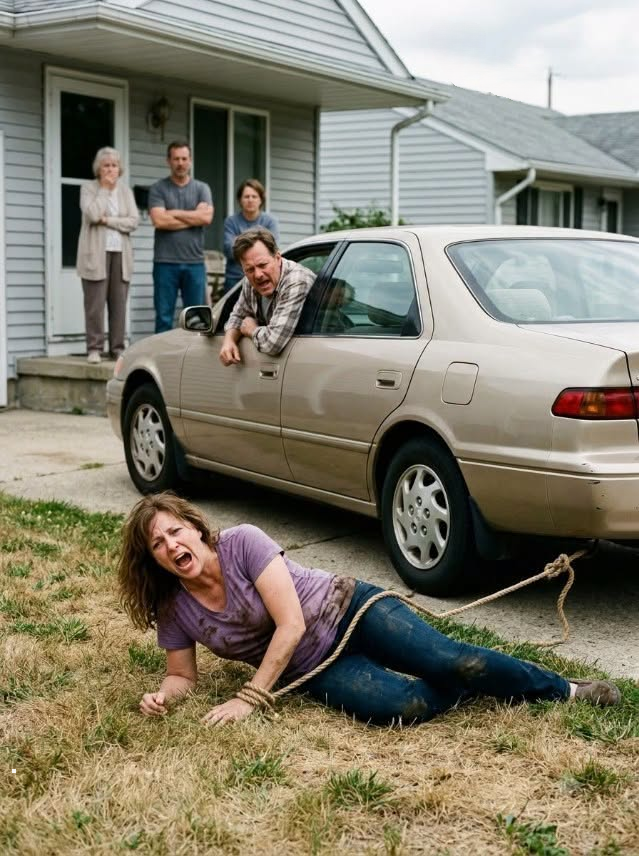
My legs were already incapacitated when my husband tied me to the rear of his vehicle and dragged me across the yard while onlookers stood by.
I couldn’t rise to stop him, and each effort to move only highlighted how utterly reliant I had become on others.
My elbows scraped against the ground as I heard laughter surrounding me, while my husband continued to yell for everyone to observe me.
“Look at her now,” he shouted, seemingly convinced that my physical limitations rendered me powerless.
But he made one crucial error that altered everything.
He overlooked the fact that I could still speak.
So I inhaled deeply and cried out the first name that popped into my head.
“Allison!”
Her laughter ceased immediately.
She promptly stopped smiling.
The phone she had been holding gradually lowered to her side, and suddenly the woman who had appeared so amused no longer knew where to direct her gaze.
I called out another name.
Then another.
Then another.
With each name, the mood in the yard shifted.
Those who had been laughing moments before began to step back.
Some directed their gaze toward my husband.
Others exchanged looks with one another.
A few suddenly found the ground to be of great interest.
But I persisted in speaking.
Because although my body could no longer perform as it once did, my memory remained vividly intact.
I recalled every person present.
I recognized every face.
I remembered who laughed.
I remembered who recorded.
I remembered who encouraged him.
And I remembered who merely stood by and watched.
For months, my husband had persuaded those around us that my physical state rendered me difficult, dependent, and incapable of making decisions for myself.
That afternoon, he aimed to publicly showcase his narrative.
Instead, he inadvertently created a list of witnesses.
My name is Elena, and prior to everything changing, I never envisioned that those closest to me could become spectators to my humiliation.
I had always viewed myself as self-sufficient.
I worked.
I traveled.
I managed our home.
I made decisions without needing anyone to assist me in daily life.
Then an unforeseen medical issue altered everything.
My legs became severely impaired.
Simple tasks turned into challenges.
Moving from one room to another required careful planning.
Standing for long periods became impossible.
Activities I once performed without a second thought suddenly necessitated help.
Initially, my husband appeared supportive.
He drove me to appointments.
He assisted around the home.
He told friends that we would navigate the tough times together.
I believed him.
I thought our marriage was being tested by circumstances, not by character.
But gradually, his demeanor shifted.
His patience vanished.
Minor frustrations escalated into arguments.
He began complaining about the added responsibilities.
Then he started referring to me as if I were a burden rather than his spouse.
When friends came over, he occasionally made jokes about my condition.
At first, I laughed along to avoid making anyone uncomfortable.
Eventually, I ceased laughing.
That was when I came to an important realization.
My husband wasn’t grappling with my condition.
He was growing comfortable with my vulnerability.
The more reliant I became, the more control he seemed to desire.
He started making decisions without consulting me.
He dominated conversations with relatives.
He told others I was “difficult.”
He insinuated that I was exaggerating my limitations.
And whenever I protested, he reminded me that I needed his assistance.
“You can’t even stand without help,” he once remarked.
That sentence lingered with me.
Not because it was entirely untrue.
But because he used it as if physical dependence equated to intellectual or emotional dependence.
I couldn’t stand.
That didn’t mean I couldn’t comprehend.
I couldn’t walk normally.
That didn’t mean I couldn’t recall.
And just because I couldn’t physically defend myself didn’t mean I couldn’t speak the truth.
The incident in the yard unfolded during a gathering that was meant to be casual.
Several acquaintances and relatives had come to our property.
Music was playing.
People were conversing.
Some were drinking.
I had remained inside for most of the afternoon.
Then my husband approached me.
His mood was already hostile.
He said something that I could barely grasp.
Before I could respond, the situation escalated.
What ensued was both humiliating and terrifying.
I was taken outside and restrained in a manner that left me unable to move freely.
People were watching.
Instead of assisting, several began to laugh.
I heard someone say that my husband was “teaching me a lesson.”
Another person raised a phone.
My husband shouted for everyone to look at me.
I remember thinking that this couldn’t possibly be real.
These were people I knew.
People who had dined at my table.
People who had accepted invitations to my home.
People who had expressed care for me.
Yet they stood there observing.
For a moment, I felt utterly powerless.
Then something inside me shifted.
If I couldn’t physically halt what was happening, I could still identify everyone witnessing it.
I inhaled.
And I yelled.
“Allison!”
Her laughter stopped.
She looked directly at me.
I shouted another name.
The person immediately ceased recording.
Then I named someone else.
A man near the fence turned away.
Another woman began to cry.
My husband commanded me to stop.
I didn’t.
“You think I don’t know who’s here?” I shouted.
No one replied.
“You think I won’t remember?”
The yard fell silent.
I continued naming people.
Each name seemed to strip away another layer of protection from those present.
They had apparently believed that because I was physically vulnerable, I would later be unable to articulate what had transpired.
They were mistaken.
I knew precisely what I was witnessing.
I recognized exactly who was there.
And I understood exactly what they were doing.
One woman finally stepped forward.
“Stop,” she told my husband.
He turned toward her angrily.
“Stay out of this.”
She looked at me.
Then she glanced at the others.
“I don’t think this is okay.”
That was the first moment anyone confronted him.
Another person moved toward the house.
Someone else put their phone away.
The laughter vanished entirely.
My husband suddenly realized that the audience he had gathered was no longer on his side.
They were becoming witnesses against him.
He began to explain.
He claimed I was being dramatic.
He asserted it was a misunderstanding.
He insisted everyone was joking.
But the individuals standing there had already heard his words.
They had witnessed what occurred.
And now they understood I had memorized their identities.
I was eventually assisted inside.
I remember sitting there trembling, unable to grasp how swiftly my life had transformed.
The physical pain was one thing.
The emotional realization was another.
I had spent months believing my husband was the one protecting me.
That day, I realized I needed protection from him.
The following morning, I began documenting everything.
I recorded what I remembered.
I noted dates.
I listed names.
I saved messages.
I documented past incidents that I had previously dismissed as isolated arguments.
For the first time, I stopped telling myself that each event was “not that serious.”
When you endure something frightening repeatedly, you can become oddly adept at rationalizing it.
You tell yourself that tomorrow will be different.
You convince yourself that the other person was just stressed.
You assure yourself that marriage requires patience.
You remind yourself that family matters should stay private.
But ultimately, privacy can turn into a prison when it prevents you from seeking help.
I reached out to trusted individuals.
I spoke with professionals.
I made arrangements to stay somewhere safe.
And I preserved the evidence I had.
Meanwhile, my husband started telling people a completely different version of the story.
He claimed I had misunderstood everything.
He said I had become emotionally unstable due to my medical issues.
He suggested I had exaggerated what occurred.
But there was one problem.
Too many people had witnessed it.
And I had named them.
Allison eventually reached out to me.
Her message was brief.
“I am sorry.”
I didn’t respond immediately.
A few hours later, she sent another message.
“I shouldn’t have laughed.”
Then another.
“I was uncomfortable, but I didn’t know how to react.”
I finally replied.
“You could have helped.”
She didn’t respond for several minutes.
Then she wrote:
“You’re right.”
That sentence held significance for me.
Not because it changed what transpired.
It didn’t.
But because someone finally acknowledged the distinction between being confused and choosing not to act.
Other witnesses eventually came forward as well.
Some admitted they had recorded parts of the incident.
Others recounted what they had seen.
Several acknowledged that my husband had acted aggressively toward me before.
Their accounts weren’t identical.
But collectively, they painted a consistent picture.
The person I had trusted most had been using my physical limitations as a means of control.
And the people around him had grown accustomed to observing.
My family was shocked when they uncovered the truth.
Some blamed themselves for not recognizing the signs sooner.
Others questioned why I hadn’t confided in them.
That question was tough to answer.
Because when you’re entrenched in a complicated situation, you don’t always know how to label it.
You convince yourself things aren’t serious enough.
You worry people won’t believe you.
You fear destroying your family.
You dread becoming a burden.
And sometimes, you simply grow exhausted.
I had expended so much energy trying to navigate each day that I hadn’t had the strength to explain the entire narrative.
But the moment I began documenting everything, I regained something I hadn’t realized I had lost.
Control.
Not physical control.
Something more fundamental.
The ability to determine what happened next.
I was no longer waiting for my husband to change.
I was no longer waiting for someone else to recognize the issue.
I was making decisions for myself.
The individuals who had laughed that afternoon eventually had to confront their own actions.
Some apologized.
Some vanished.
Some insisted they hadn’t comprehended the gravity of the situation.
I accepted some apologies.
I rejected others.
Because forgiveness is not synonymous with forgetting.
And an apology doesn’t automatically restore trust.
Allison was among the few who continued striving to make amends.
She ultimately confessed that she had laughed due to her discomfort and uncertainty about how to respond.
I told her that discomfort wasn’t an excuse.
She agreed.
“I should have intervened,” she said.
“Yes,” I replied.
That was all.
There was no dramatic reconciliation.
No emotional embrace.
Just an uncomfortable truth.
Sometimes people don’t become cruel with intent.
Sometimes they become cruel because they fear standing alone.
But the result for the person being harmed can be indistinguishable.
Months later, I began rebuilding my life.
My physical recovery remained complex.
There were good days and bad days.
Some days I could achieve more than expected.
Other days demanded significant assistance.
But emotionally, I felt stronger than I had in years.
I learned not to gauge my worth by what my body could accomplish.
My husband had thought that stripping away my physical independence would diminish everything else.
Instead, it compelled me to discover a different form of strength.
I learned how powerful documentation could be.
I learned how crucial witnesses could become.
I learned that silence can shield the wrong individual.
And I learned that asking for help is not a sign of weakness.
The yard where the incident occurred eventually became just another location.
Initially, I couldn’t think of it without recalling the laughter.
Over time, I stopped hearing the laughter.
I began remembering something else.
The moment Allison’s smile faded.
The moment the onlookers realized I knew their names.
The moment my husband understood that his audience was no longer cheering.
That was the moment everything shifted.
He had believed the scene would showcase my helplessness.
Instead, it revealed his character.
He thought people would laugh with him.
Instead, they ultimately had to rationalize why they had laughed at all.
And he believed my inability to stand meant I couldn’t fight back.
He never grasped that fighting back doesn’t always require physical strength.
Sometimes fighting back means speaking.
Sometimes it means documenting.
Sometimes it means telling the truth when everyone around you wishes you to remain silent.
And sometimes, the most powerful thing a person can do is simply assert, “This happened, and I will not pretend it didn’t.”
Reflecting back, I still wish that afternoon had never occurred.
I wish someone had stepped up right away.
I wish I hadn’t needed to shout names before anyone recognized how wrong the situation was.
But I cannot alter what transpired.
What I can change is what followed.
I can refuse to let humiliation define my identity.
I can refuse to allow physical limitations to dictate my value.
And I can refuse to let anyone convince me that needing assistance equates to surrendering my voice.
The individuals in that yard thought they were observing someone who couldn’t fight back.
They were mistaken.
They were witnessing someone who had finally realized that her voice was sufficient to unveil the truth.
“Allison!”
That single name transformed the atmosphere.
The laughter ceased.
The phones lowered.
The excuses began.
And one by one, the individuals who had believed they were merely spectators recognized that they were witnesses.
I couldn’t stand that day.
But I stood up in another manner.
And sometimes, that is where genuine strength begins.