The line connected almost instantly, and my sister's voice came through the nurse's phone while Luke stood a few feet away with nothing left to interrupt.
Her name was Beth.
I hadn’t heard her voice in nearly three years.
The nurse held the phone close to my bed, and Beth said my name once, paused, then inquired if I could hear her.
I moved two fingers against the sheet.
Barely anything.
Enough.
Luke approached us and informed the nurse that family calls drained me, but she raised one hand without glancing at him and kept the phone positioned where it was.
The room was chilly enough that my exposed fingertips throbbed, and somewhere outside the door, a cart rolled over a faulty wheel with the same soft click every few seconds.
Beth began to ask questions.
Not about Luke.
About me.
Could I speak?
Was I awake?
Did I know where I was?
I responded when I could.
Yes.
Yes.
Hospital.
Luke made another attempt.
“She needs rest,” he stated. “Her sister has always made these situations worse.”
Beth heard him.
The silence on the line shifted.
Then she said, “Put the doctor back on.”
Luke's expression tensed.
The doctor took the phone and moved toward the window, speaking softly while I observed Luke watching her.
He couldn’t hear every word.
Neither could I.
That troubled him more than shouting would have.
He had spent years ensuring every conversation regarding me went through him first.
He answered my calls.
He read messages over my shoulder.
He informed people when I was too fatigued to talk, too emotional to visit, too ill to travel, too confused to remember.
Now people were discussing my safety while he stood outside the dialogue.
I watched him reach for his own phone.
I watched the nurse notice.
I observed her step between him and my bed.
He lowered it.
The doctor returned several minutes later and informed Luke that the hospital needed to speak with me in private.
He smiled.
“Of course,” he said. “Whatever Caroline needs.”
That voice again.
Warm.
Patient.
Concerned.
The nurse opened the door.
Luke didn’t move.
The doctor reiterated herself.
This time he looked at me.
“You want me here, don’t you?”
My mouth felt split at the corners, and even breathing made the bandages across my chest tug.
I looked at the door instead.
“Out.”
He stared at me.
I repeated it.
“Out.”
The nurse held the door.
Luke walked through it.
He moved slowly enough to make his departure feel temporary.
Once the latch clicked shut, I tried to smooth a wrinkle in the blanket with my palm, but my hand barely shifted the fabric.
The doctor pulled a chair closer.
Her name was Dr. Harris, and she asked if Luke had caused the burns.
“Yes.”
She inquired if he had harmed me before.
“Yes.”
She asked if I believed I would be safe if I went home with him.
My response came quicker.
“No.”
No explanation.
No apology.
No.
A hospital social worker arrived later that afternoon carrying a yellow legal pad and a cup of coffee she never touched.
Her name was Dana, and she asked me what Luke controlled.
I began with the bank account.
Then the phone.
Then the car keys.
Then the mail.
Then the passwords.
Dana paused writing for a moment when I told her he had changed my number after Beth kept calling.
“Do you know the old number?” she asked.
I did.
I recited it from memory.
Luke had taken the phone.
He had taken the account.
He had taken the service.
He had never been able to erase the ten digits from my mind.
Dana wrote them down.
The scent of burnt coffee wafted from the hall whenever the door opened, and an untouched packet of saltines lay on my tray even though I hadn’t eaten since before the ambulance arrived.
A nurse named Mara found a charging cord on the windowsill and said she thought it belonged to me.
I knew it didn’t, but I allowed her to leave it beside the bed.
By early evening, hospital security had moved Luke away from the unit after he refused twice to stay in the public waiting area.
He didn’t shout.
That would have been simpler.
Instead, he told them I frightened easily and claimed he was worried strangers were exploiting my medication.
He asked if they understood how fragile I was.
He thanked them for looking out for me.
Then he asked to see my phone.
There wasn’t one.
His smile faded for half a second.
Beth arrived before dark.
I recognized her footsteps before I saw her because she always walked too quickly and stopped too abruptly.
She entered the room wearing jeans, an old green sweater, and one earring.
She had driven without realizing the other was missing.
For a moment, neither of us spoke.
My mouth wouldn’t cooperate anyway.
She stood beside the bed and pressed both hands against the rail instead of reaching out to me.
“I’m here,” she said.
I looked at her hands.
“I know.”
She sat down.
The radiator beneath the window clicked even though the room remained cool, and Beth kept folding the paper sleeve from a drinking straw into smaller and smaller squares.
I asked the question that had been lingering inside me since the nurse dialed her.
“Why did you stop calling?”
Beth’s eyes shifted to mine.
“I didn’t.”
I waited.
She reached into her purse.
Luke had told me she stopped caring.
Beth had received a different story.
For nearly two years, whenever she called my new number, Luke answered or the call went nowhere.
When he answered, he said I didn’t want contact.
He told her I blamed her for interfering in my marriage.
He claimed I had asked him to block her.
Beth believed him at first.
Then she began calling from different numbers.
Luke stopped answering those as well.
She mailed letters.
They were returned.
She drove to our house once.
Luke met her on the porch and told her I was sleeping after another miscarriage.
She had requested to see me.
He said no.
“I should have pushed harder,” she said.
I shook my head.
It hurt.
I stopped.
“You came.”
Beth opened her purse again and pulled out an old phone with a cracked corner.
Not my phone.
Hers.
She had replaced it years ago but never discarded it because photographs from our mother’s last birthday were still saved on it.
Luke had never known that phone existed.
Beth powered it on.
The battery showed six percent.
Dana leaned closer.
I watched the screen illuminate.
Beth said she had remembered something during the drive.
A message.
Not a text.
A voicemail.
She had received it after one of my earlier pregnancies ended.
At the time, she thought I had called her crying because I was grieving.
She recalled my voice being low.
She remembered me saying I had fallen.
Most importantly, she remembered another voice behind mine.
Luke’s.
Beth had listened to that voicemail so many times after I vanished from her life that she knew something was wrong with it, but she never understood what she was hearing.
Until the hospital called.
Dana asked her not to play it yet.
Instead, she requested Beth to preserve the phone exactly as it was and allow law enforcement to properly copy the recording if Beth was willing.
Beth nodded.
I stared at the cracked glass.
For years, Luke had trained me to believe the safest evidence was evidence that did not exist.
No messages.
No photographs.
No diary.
No complaints.
Nothing he could find.
Yet one old phone had survived because my sister liked a photograph of our mother laughing over a grocery-store cake.
Luke had not planned for useless things.
That night, a detective came to the hospital.
She spoke with Dr. Harris first, then Dana, then me.
I asked Beth to stay.
The detective told me I could stop whenever I needed.
I did stop.
Twice.
Once because my throat hurt too much.
Once because I couldn’t recall whether one attack happened before Thanksgiving or sometime after.
I refused to guess.
The detective wrote down what I knew and left the uncertain date uncertain.
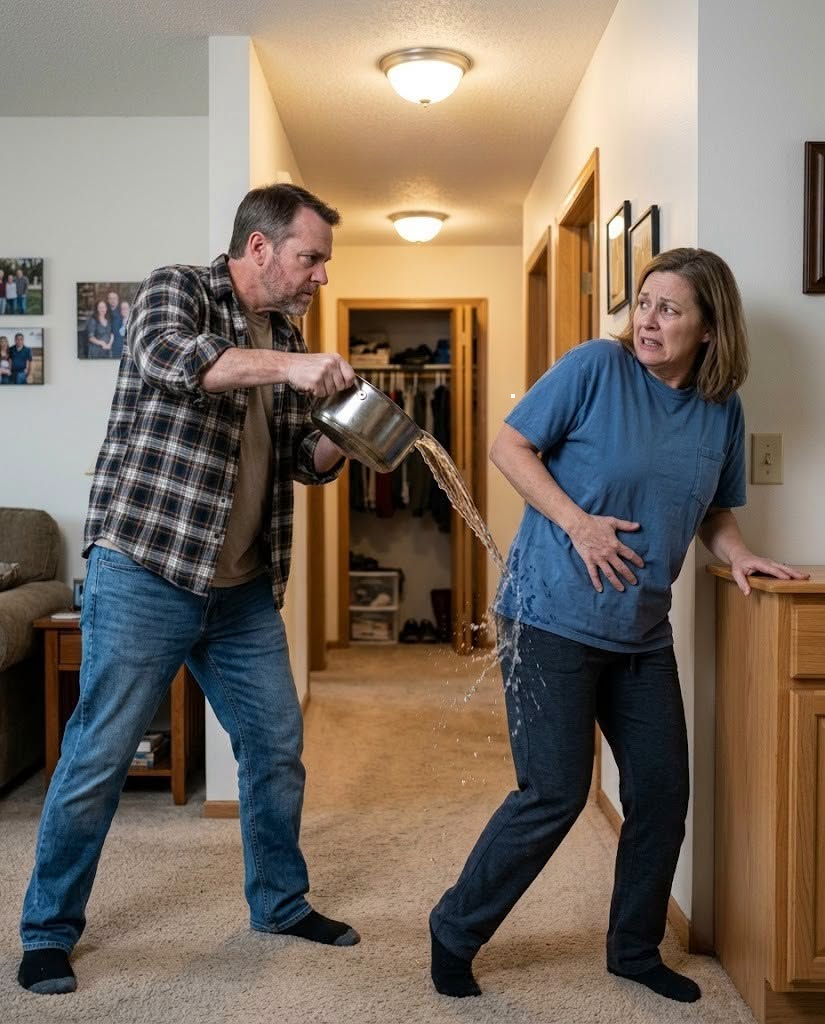
When she inquired about the boiling water, my fingers curled into the sheet.
I provided her with the sequence.
The argument.
The pot.
Luke blocking the doorway.
His hand.
The water.
Then the floor.
I didn’t embellish it.
I didn’t need to.
Dr. Harris had already documented the injuries.
The medical staff had photographed what they were required to document.
My statement gave those injuries a person and an action.
Beth’s old voicemail provided the past with a sound.
The detective left to speak with Luke.
That should have felt like progress.
Instead, the next morning everything fell apart again.
Luke had reached our bank before anyone reached our house.
The debit card linked to our joint checking account stopped functioning.
A payment Beth tried to make for a prescription was declined because the card I had carried for years was connected to an account Luke had drained overnight.
He could no longer enter my hospital room.
He could still reach the parts of my life that existed outside it.
I had won a door.
I had lost the floor beneath it.
Dana found me staring at the declined receipt Beth had brought back from the pharmacy counter.
“We can work on emergency housing,” she said.
I looked at Beth.
Beth shook her head.
“She’s coming with me.”
I had spent years hearing that I had nowhere to go.
Now I had an address before I could stand.
It didn’t solve everything.
It solved tonight.
That mattered.
Later that day, Luke sent a message through an attorney expressing concern about my mental condition and requested information about my discharge plan.
He did not apologize.
He did not admit anything.
He asked for information.
The request went nowhere because I signed paperwork limiting who could receive updates about me.
My signature looked terrible.
It counted.
I also changed the contact person on my chart.
Beth’s name replaced Luke’s.
It was a sideways change, almost mundane compared to everything else occurring.
A name on a screen.
A box checked.
A phone number entered.
But when Luke called the unit later, staff would not inform him whether I was asleep, awake, improving, leaving, or staying.
For once, a system gave him nothing.
Two days later, Beth’s phone was copied and returned.
The voicemail lasted less than a minute.
The detective played it once in the room with my consent.
I heard my younger voice first.
Weak.
Trying to sound normal.
I told Beth I had fallen near the bathroom and lost the baby.
There was movement in the background.
Then Luke’s voice came through clearly enough that nobody in the room leaned closer.
“Tell her you slipped.”
My recorded voice answered him.
“I did.”
Luke spoke again.
“Say it right.”
The message concluded six seconds later.
Nobody spoke immediately.
Beth placed both hands over the old phone.
I looked at Dr. Harris.
Then Dana.
Then the detective.
The same explanation Luke had used in my hospital room had been sitting inside Beth’s dead phone for years.
Slip.
Accident.
Careless.
Different injuries.
Same story.
The detective did not promise me what would happen next.
She stated the recording would be reviewed alongside the medical documentation and my statement.
I preferred that answer.
Promises had become cheap in my house.
Facts were better.
The following morning, a judge approved a temporary protective order after the hospital documentation and my statement were submitted through the process Dana had explained to me.
It was temporary.
It had limits.
It was paper.
I still read every line.
Luke was ordered not to contact me directly.
He could contest it later.
He could hire counsel.
He could tell another story.
What he could not do was stand beside my hospital bed and answer questions for me anymore.
A few days later, I left the burn unit for a rehabilitation floor.
Beth pushed the wheelchair because my hands were still too weak for the rims.
At the elevator, I asked her to stop.
I wanted to press the button myself.
My finger missed the first time.
I tried again.
The button lit.
Nothing dramatic occurred.
The doors opened.
We went down.
Recovery was not neat.
I woke from sleep reaching for a hand that was not there.
I panicked when Beth shut a kitchen cabinet too forcefully.
I apologized for taking too long in the bathroom.
I asked permission to use things in a house where nobody had asked me to.
Sometimes Beth responded to me.
Sometimes she simply stared until I heard what I had said.
I began physical therapy.
I met with a counselor.
I opened a bank account in my name with forty-three dollars Beth had kept in cash for emergencies.
The amount felt almost embarrassing on the first deposit slip.
I kept the receipt.
Luke contested the protective order.
His attorney argued that I had been medicated when I first accused him and that our marriage had been under severe emotional strain after repeated pregnancy losses.
My attorney did not debate whether the marriage had been strained.
She brought the hospital records.
She brought my statement.
She presented the preserved voicemail.
Beth testified about the calls, the changed number, the returned letters, and the day Luke refused to let her inside the house.
Dr. Harris testified only to what she had observed and documented.
No one needed to depict Luke as a monster.
They described what happened.
Months passed.
The criminal case progressed more slowly than I wished and faster than Luke anticipated.
His version changed again during an interview.
First the water had spilled.
Then I had pulled the pot.
Then he had been across the room.
The old voicemail created a problem he could not explain away: years before the burn, he had already been coaching me to describe another injury as a slip.
Eventually, after prosecutors reviewed the medical evidence, the recording, witness statements, and the documented inconsistencies in his accounts, Luke entered a guilty plea to a felony assault charge rather than take the case to trial.
The court imposed its sentence months after I left the hospital.
I wasn’t in the courtroom when he was taken away.
Beth went.
I stayed home and made soup poorly.
It was too salty.
I ate it anyway.
The financial separation took longer.
Some money was recovered through the divorce process.
Some was spent on lawyers, treatment, and starting anew.
There was no sudden fortune waiting for me.
There was a small apartment eventually.
There was a secondhand table.
There was a pharmacy bill taped to the refrigerator because I kept forgetting the due date.
There was a mattress on the floor for nearly a month because Beth and I couldn’t get the frame upstairs.
There was also a front door Luke did not have a key for.
One afternoon, Beth placed a small prepaid phone on that secondhand table.
“Temporary,” she said.
I picked it up.
The setup screen asked for a passcode.
Beth turned her chair around so she could not see what I entered.
Four digits.
Mine.
Then the phone asked if I wanted to transfer an old number or create a new one.
I stared at the screen for a moment.
Luke had changed my old number to cut Beth from my life.
Beth’s saved number had brought her back.
Her old phone had carried a voice Luke thought had vanished.
I selected the option for a new number.
The phone generated it.
Beth asked if I wanted her to write it down.
I took the pen instead.
The number was mine.